Home wound care service is a home health service in which the wounds of individuals who have become dependent on their home or bed due to a diagnosed illness are evaluated and monitored in their own living environment, accompanied by a physician and nurse. Within the framework of the Ministry of Health, home health services are defined as a whole encompassing examination, medical care, and wound care. In other words, wound care is not merely a dressing change on its own, but part of regular medical evaluation.
As the Private Dr. Emin Paçacı Home Care Center, we address wound care within this holistic framework. In this article, we explain in a neutral manner what home wound care means, which wounds it covers, the role of the physician and nurse, and which criteria stand out when considering care support.
Contents
What home wound care is and how it works
Home wound care is the planned evaluation of a wound in the home environment and the monitoring of the healing process. In the official definitions of public home health units, home examination, medical care, and wound care are all included within the same scope of service (Haseki Training and Research Hospital Home Health Services Unit definition). This shows that wound care is not an isolated procedure, but a component of medical monitoring.
The essence of the process is that the wound is managed according to clinical principles rather than randomly. Clinical resources related to wound care emphasize the evaluation of the patient's general condition, nutrition, pain, mobility, and pressure points; ensuring an appropriate moist wound environment; controlling infection and exudate; and planning necrotic tissue management when necessary (Aydın State Hospital Wound Care information). In other words, the dressing material is the result of a medical decision made according to the type of wound and its healing stage.
These decisions need to be reviewed regularly. A wound may show changes in color, discharge, or the surrounding tissue within a few days. For this reason, the home health framework is built upon a documented monitoring plan rather than one-time care of the wound.
Wound types and their differences in home care
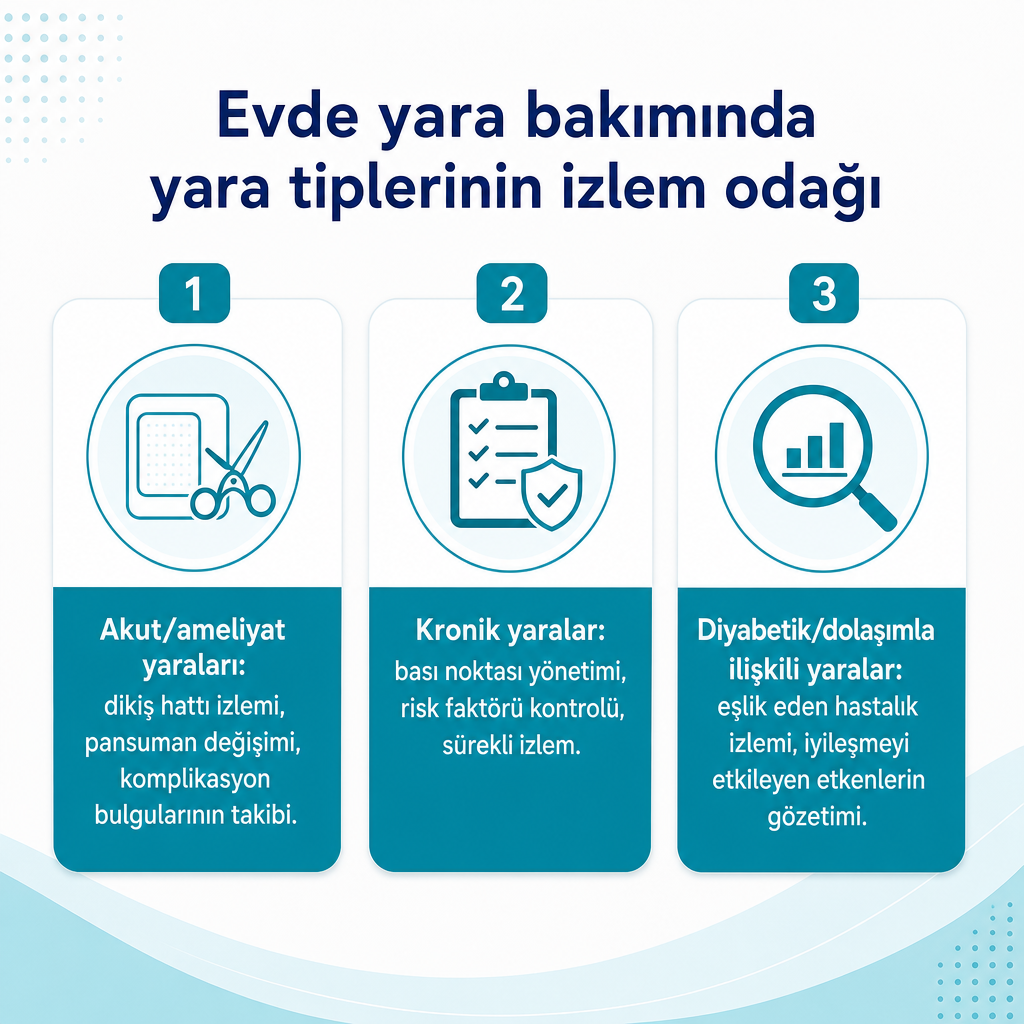
Home wound care comes into consideration not for a single wound presentation, but for many conditions with clinically different characteristics. These differences change the frequency of monitoring and the focus of care.
- Acute wounds and surgical wounds: In the postoperative period, monitoring the suture line, changing dressings, and early detection of possible complication signs come to the forefront. In this presentation, the process generally follows a defined course that progresses toward healing.
- Chronic wounds: Pressure-related wounds that can develop in individuals who have been bedridden for a long time are evaluated in this group. These wounds require continuity in managing risk factors, controlling pressure points, and monitoring factors that hinder healing.
- Diabetic and circulation-related wounds: These are presentations where underlying metabolic and vascular conditions affect the course of the wound. Here, wound care is considered together with the monitoring of the accompanying illness.
Clinical resources indicate that in deep and non-healing ulcers, a surgical approach may be evaluated, while in superficial and controllable wounds, a medical wound care plan comes to the forefront (Aydın State Hospital Wound Care information). What makes this distinction is the type and stage of the wound; therefore, determining which approach is appropriate requires a separate physician evaluation for each patient.
The combined role of physician, nurse, and physiotherapist
Thinking of home wound care as the job of a single professional group is a common misconception. The Ministry of Health directive defines a framework in which physicians, nurses, and other health professionals take part together in the home health team; and evaluation, treatment plan, and follow-up are documented (Ministry of Health Home Health Services Directive).
Within this framework, the complementary nature of the roles determines the quality of wound care. The physician is responsible for diagnosing the wound, creating the treatment plan, and updating the plan when a new finding develops. Our home private physician service provides the basis for this evaluation in complicated wounds and accompanying chronic illnesses. The nurse, in line with the plan, carries out processes such as applying dressings, monitoring the wound, and reporting changes to the physician; these processes are planned within the scope of our home private nursing service.
The role of physiotherapy is often overlooked. In patients who have been bedridden for a long time or who have limited mobility, mobilization, management of pressure points, and support of circulation indirectly affect the wound's healing conditions. When this need arises, home physiotherapy service can be evaluated as part of the care plan. Structuring the roles together in this way transforms wound care from a single application into a monitored chain of care.
Why it matters for these patient profiles
Home health service primarily benefits individuals who are dependent on their bed, home, or a device. The Ministry of Health-supported national model defines home health service as a whole of medical services provided to these individuals in the place where they continue their lives (Integrated Home Health and Care Services National Model Proposals.pdf). This definition also shows for whom home wound care can be clinically meaningful.
For a patient with limited mobility who requires frequent dressing changes, traveling to the hospital for every wound check can be both exhausting and, at times, a burden that disrupts the continuity of wound monitoring. Regular evaluation of the wound in its own environment offers a practical option in terms of this continuity. In the postoperative period, monitoring the suture line and possible complication signs within nursing follow-up is also important; our content on postoperative home nursing care, which we address in more detail, explains the scope of the process.
In patients who have been bedridden for a long time and carry the risk of pressure sores, the uninterrupted nature of monitoring is decisive. The aim in uninterrupted monitoring is to detect changes in the course of the wound early during the day and to convey information to the physician when necessary. Thus, thanks to regular follow-up, a finding can be evaluated at its very onset. In other words, the value of home wound care becomes clearer with the patient's overall presentation rather than with a single patient.
What to consider when thinking about home wound care support
When evaluating care support, the decision becomes clear not with a single criterion, but by considering several dimensions together. The criteria below are not a procedure, but judgment points to be addressed together with the physician's evaluation.
- Type and stage of the wound: A superficial and controllable wound and a deep wound with prolonged healing require different approaches. Only a health professional can make this distinction.
- The patient's general condition: Nutrition, circulation, accompanying chronic illnesses, and the level of mobility significantly affect healing (Aydın State Hospital Wound Care information). Whether additional physiotherapy or nutritional support is needed in these areas can be evaluated.
- Continuity of monitoring: How often the wound needs to be checked and whether this frequency is sustainable in the home environment are important. In patients who have been bedridden for a long time, uninterrupted follow-up during the day contributes to the early detection of changes in the wound's course; this continuity should be structured together with the patient's overall care plan.
- Compatibility with existing health services: Public home health units, in their official definitions, cover home examination, medical care, and wound care. Private home care support can be considered not as an alternative to these public services, but as a complementary option in line with the physician's guidance.
Symptoms and the course of healing vary from person to person; the evaluation, diagnosis, and treatment decision regarding which form of care is appropriate belong to a physician. For this reason, before discussing home wound care support, it is a logical starting point for the patient's wound condition and general presentation to be evaluated by a physician. We address the place of home physician examination in this process in detail in our guide to home doctor examination in Istanbul.
Frequently Asked Questions
What exactly does the home wound care service cover?
Home wound care includes the evaluation of the wound in the home environment, the monitoring of an appropriate care plan, and the follow-up of the healing process. In public home health definitions as well, wound care is included within the same scope of service together with examination and medical care. The scope and frequency are determined by physician evaluation.
Can I do wound care myself at home?
Wound care involves medical decisions such as controlling infection and discharge, ensuring an appropriate wound environment, and managing necrotic tissue when necessary. These decisions need to be made by a physician or nurse, and regular medical follow-up must be carried out. It is recommended to consult a health professional for evaluation.
For which wounds can home wound care be considered?
Different presentations such as acute and surgical wounds, pressure sores due to prolonged bedriddenness, and diabetes and circulation-related wounds can be evaluated within the scope of home wound care. Which approach is appropriate varies according to the type and stage of the wound and the patient's general condition.
How are the roles of the physician and nurse divided in home wound care?
The physician takes on the diagnosis of the wound, the treatment plan, and the updating of the plan when a new finding develops. The nurse, in line with the plan, carries out processes such as applying dressings, monitoring the wound, and reporting changes to the physician. The legislation places this team structure within a defined framework.
Does home wound care replace public home health service?
No. Public home health units cover wound care in their official definitions. Private home care support can be considered not as an alternative to public service, but as an option that can complement it in line with the physician's guidance.