Bedridden patient home care follows a regular daily plan that preserves the patient's comfort and safety; it involves many successive steps ranging from room arrangement to position changes, from nutrition to skin monitoring. A significant portion of these steps can be undertaken by the family; interventional procedures such as positioning technique, pressure ulcer monitoring, vascular access, and catheters, however, are the responsibility of healthcare professionals. Below, we describe in concrete terms the parts the family can safely perform, and explain at which point physician, nurse, and physiotherapist support comes into play. For the basic concepts of bedridden patient care, you can review our article on the duties of a home care nurse and how to choose one.
Contents
Preparation Before Starting Bedridden Patient Home Care
The quality of care is largely determined by the proper preparation of the patient's room and basic supplies. Ventilating the room and maintaining the balance of temperature and humidity are important for both skin health and respiratory comfort. Public and clinical guidelines recommend keeping the room temperature at approximately 18–25 °C, humidity in the range of 30–60%, and the environment clean, quiet, and organized.
Basic items that are useful to have on hand before starting:
- Bed and sheets: Easy-to-clean sheets that can be laid out wrinkle-free; protective covers when needed.
- Support pillows: Pillows that make positioning and relieving pressure areas easier.
- Pressure ulcer prevention equipment: Air mattresses and protectors for prominent areas such as the heels; these help reduce risk by distributing pressure.
- Skin and hygiene supplies: Moisturizer, wet/dry cleaning products, appropriate materials for mouth and eye care.
- Log book: A simple tracking chart where position change times, fluid intake, nutrition, and observations are noted.
The family can easily undertake the majority of this preparation. However, creating a care plan appropriate to the patient's diagnosis, determining which equipment is necessary, and how the positioning technique should be applied safely become clear through physician and nurse evaluation. For a physician to conduct a general condition assessment at home, our home private physician service comes into play, and for daily care support and interventional applications, our home private nursing service comes into play.

Step-by-Step Daily Care Plan: Family and Professional Team Collaboration
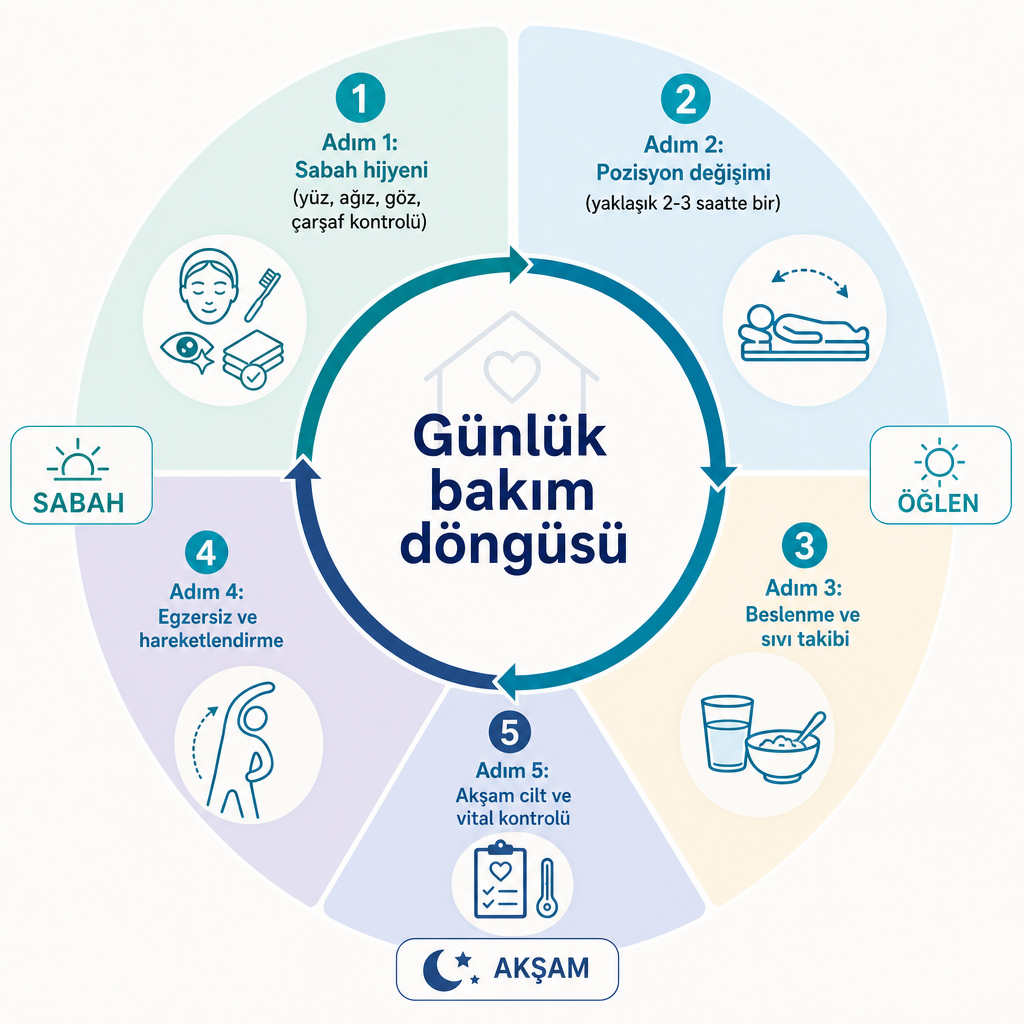
Daily care of a bedridden patient is a repetitive cycle spread out from morning to evening. The sequential plan below shows together the parts the family can naturally undertake and the topics where the healthcare professional comes into play. Values such as frequency and portions are general recommendations; they are adapted through physician evaluation according to the patient's diagnosis.
- Morning preparation and hygiene. The face, mouth, eyes, nose, and ears are cleaned; mouth care is repeated regularly to prevent food residue from accumulating. The sheet is checked and laid out wrinkle-free; damp or soiled covers are changed. The skin is observed. The part the family will do: daily personal hygiene and sheet arrangement. The part where the professional comes into play: nurse evaluation if there is a change in mouth or skin findings.
- Position change cycle. To prevent pressure from accumulating in the same area, the position is changed approximately every 2–3 hours; pressure areas are supported with pillows. This cycle is the fundamental way to reduce the risk of pressure ulcers. The part the family will do: regular position changes using the learned safe technique. The part where the professional comes into play: teaching of safe transfer and positioning technique by a physiotherapist.
- Nutrition and fluid monitoring. Small portions that are easy to swallow are preferred; protein-rich, balanced nutrition and, if appropriate, adequate fluid intake (general recommendation of approximately 1.5–2 liters per day) are targeted. It is ensured that no food remains in the mouth after eating. The part the family will do: implementing and monitoring the meal plan. The part where the professional comes into play: physician and nurse evaluation if there is difficulty swallowing, risk of aspiration, or a feeding tube.
- Exercise and mobilization. To prevent muscle wasting and joint stiffness (contracture), the exercise program determined by the physician is applied during the day. The part the family will do: continuing the simple exercises that have been taught. The part where the professional comes into play: the planning and progression of the passive/active exercise program by a licensed physiotherapist within the scope of home physiotherapy.
- Evening evaluation. At the end of the day, the skin is checked again, especially the pressure areas (hips, heels, elbows, back) are examined; discoloration, redness, or openings are noted. The part the family will do: observation and recording. The part where the professional comes into play: nurse and physician evaluation in cases of suspected pressure ulcers or changes in vital signs.
In this cycle, the routine observation undertaken by the family forms the heart of the process; interventional procedures, on the other hand, are the responsibility of our team. If openings have developed in pressure areas or the risk is high, we carry out wound management according to the principles of home wound care and infection prevention, in coordination with a nurse and physician.
Common Mistakes and How to Prevent Them
The most common problems encountered in home care usually stem from small but recurring oversights. Knowing these in advance significantly reduces the risks.
- Leaving the patient in the same position for a long time. Prolonged pressure on the same area leads to tissue damage and pressure ulcers. Precaution: write position change times on a chart and follow them regularly.
- Leaving the sheet wrinkled. Wrinkles create additional pressure on the skin. Precaution: lay the sheet taut and smooth at every position change.
- Leaving the skin too dry or too moist. Both extremes disrupt skin integrity. Precaution: keep the skin clean and at balanced moisture; clean areas dampened by urine or sweat without losing time.
- Feeding with large portions and quickly. This increases the risk of aspiration (food entering the windpipe). Precaution: small portions, an appropriate sitting angle, and mouth checks after feeding. If vomiting occurs, turning the patient onto their side is an appropriate first precaution; however, recurring aspiration risk requires physician evaluation.
- Doing exercise irregularly or not doing it at all. Immobility accelerates muscle wasting and joint stiffness. Precaution: regularly continue the program determined by the physiotherapist.
Most of these mistakes can be prevented once the correct technique is learned. Demonstrating the positioning and exercise technique in the home environment increases the family caregiver's confidence and makes the process more controlled.
What Can You Do at Home, and at Which Point Is Professional Support Needed?
This distinction is decisive both for the patient's safety and for the sustainability of the caregiver's burden. Below, we show the boundaries in concrete terms.
Topics the family can safely undertake:
- Ventilating the room, ensuring temperature and humidity control, a clean and organized environment.
- Daily personal hygiene: face, hands, hair, mouth, eye care.
- Keeping sheets clean, dry, and wrinkle-free.
- Continuing the taught safe position change and simple exercise program.
- Monitoring nutrition and fluid intake, recording daily observations.
Topics requiring a licensed healthcare professional:
- Advanced wound care and dressing in patients who have developed pressure ulcers or are at high risk.
- Vascular access (serum/IV), injection, and infusion monitoring.
- Care of interventional devices such as urinary catheters, feeding tubes (PEG), tracheostomy.
- Evaluation of conditions such as difficulty swallowing, aspiration risk, respiratory distress.
- Symptom management and clinical interpretation of changes in general condition.
Interventional procedures such as medication administration, vascular access, catheters, and advanced wound care are the responsibility of healthcare professionals, as also emphasized in public home health guidelines. We carry out these topics with our home private nursing team, in coordination with a physician and physiotherapist when needed. In bedridden patient care, with a personalized care plan created together by a physician, nurse, and physiotherapist, we combine the family's daily practices with professional follow-up. When there is a sudden change in general condition, we support the safe conduct of the process with 24/7 medical evaluation and, when necessary, transfer organization. When you inform us of the region where the patient is located, the scope of the care need, and which service combination is appropriate, we can evaluate together to prepare a care plan suitable for you.
Symptoms and care needs vary from person to person; which procedures are appropriate at home and how they will be applied are determined by the patient's evaluation by a physician.
Frequently Asked Questions About Bedridden Patient Home Care
How often should the position be changed?
The general recommendation is to change the position approximately every 2–3 hours to prevent pressure from accumulating in the same area. This interval may vary according to the patient's skin condition, mobility restrictions, and pressure ulcer risk; the appropriate frequency is clarified through physician and nurse evaluation.
In which case is physician or nurse evaluation needed for pressure ulcers?
Professional evaluation is needed when persistent redness, discoloration, an opening in skin integrity, or discharge is noticed in pressure areas. In advanced-stage wounds and in cases of suspected infection, wound management must be carried out under the responsibility of a nurse and physician.
When is home physiotherapy started for a bedridden patient?
The exercise and rehabilitation program is planned through physician and physiotherapist evaluation according to the patient's diagnosis and general condition. The aim is to start appropriate passive or active exercises in a timely manner to prevent muscle wasting and joint stiffness. The starting time and the content of the program are determined individually.
How is nutrition and fluid monitoring planned?
Small portions, easy-to-swallow foods, and, if appropriate, balanced fluid intake are the basic approach. However, portion, content, and fluid amount vary according to the patient's diagnosis, swallowing condition, and feeding tube, if any. For this reason, it is recommended that the nutrition plan be shaped through physician evaluation and, when necessary, with dietitian guidance.
What are the task boundaries between the home care nurse and the family caregiver?
The family caregiver undertakes routine tasks such as hygiene, room arrangement, sheet monitoring, taught position changes, and nutrition monitoring. The nurse, on the other hand, carries out interventional and clinical tasks such as vital sign monitoring, injections, serum/IV, catheter and cannula care, advanced wound care, and coordinates the process with the physician.
In which regions of Istanbul do you provide home care support?
Based in Üsküdar, we provide services within Istanbul through home visits. When you inform us of the region where the patient is located, the scope of the care need, and your preferred service combination, we can evaluate together to prepare a plan suitable for you.