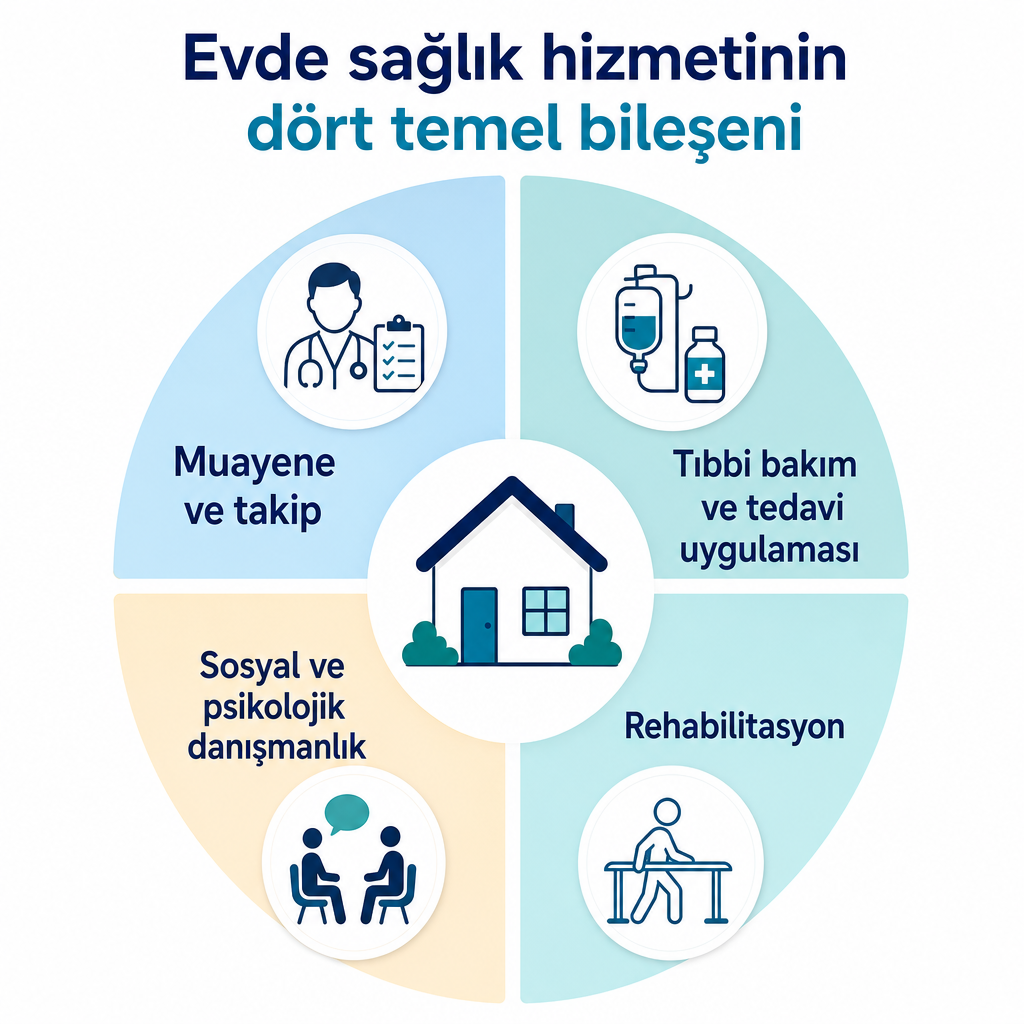
Ministry of Health home care services is a medically focused health service in which examination, testing, analysis, treatment, medical care, follow-up and rehabilitation, along with social and psychological counseling, are provided to individuals who have difficulty leaving their homes or have limited mobility, in their home and family environment. On the public side, this service is carried out through home health units within hospitals. Below, we explain this framework, the differences between concepts, and the place of a private home health institution within this structure.
As the Private Dr. Emin Paçacı Home Care Center, we are a Ministry of Health-licensed home health institution based in Üsküdar. We prepared this article to clarify the concepts that families frequently confuse and to help them see under which service category their own situation should be evaluated.
Table of Contents
What is Ministry of Health home health service and how does it work
The official definition of home health service is found in the Directive on the Procedures and Principles for the Implementation of Home Health Services Provided by the Ministry of Health. According to the directive, this service covers examination, testing, analysis, treatment, medical care, follow-up and rehabilitation, as well as social and psychological counseling services provided to the individual in need in their home and family environment. In other words, it is not a one-time visit but a continuous follow-up process.
There is an important detail in terms of the mechanism: the primary duty of public home health units is not to make a new diagnosis of a disease. These units take on the home follow-up of treatment, medical care and rehabilitation for patients whose diagnosis has already been made by relevant specialists and whose treatment has been planned. Public hospital sources also emphasize that the function of home health teams is to provide care and rehabilitation in the home environment within the framework of planned treatment, and to provide education to patients and caregivers.
On the public side, the service is carried out through home health units and coordination centers established within hospitals across the country. Access is provided through a nationally coordinated structure; official sources such as the Republic of Turkey Ministry of Family and Social Services information page list the national call center number 444 38 33 for application channels.
The framework of the service has been updated in recent years. The Regulation on the Provision of Home Health Services published in the Official Gazette dated June 2, 2023 renewed the provision framework; subsequently, another new regulation was introduced in which home health and palliative care are addressed together. These updates show that administrative details may change over time; therefore, for up-to-date criteria, it is appropriate to consult the text of official sources valid at that date.
Home health, home care and social assistance: how the concepts differ
Since these three concepts are used interchangeably in everyday language, confusion is common. Seeing the difference between them makes it easier to choose the right point of application.
Home health service is the medically focused service described above: it covers elements such as examination, testing, treatment follow-up, nursing practices and rehabilitation. It draws its basis from health legislation.
The concept of home care service, on the other hand, is based on a broader legislative foundation. The Regulation on the Provision of Home Care Services published in the Official Gazette dated March 10, 2005 regulates the procedures and principles regarding the provision of these services. In practice, this category defines an area where daily life support and medical care for the elderly, disabled or chronically ill patients intersect.
The social assistance category (for example, home care support payments) is not a health service but a social policy instrument and is subject to a different administrative framework. A mistake families frequently make is to assume that a social assistance program and home medical service are the same door. The subject of this article is the health service; payment programs should be considered as a separate topic.
The practical distinction can be summarized as follows:
| Concept | What it provides | Basis |
|---|
| Home health service | Examination, treatment follow-up, nursing, rehabilitation | Health legislation |
| Home care service | The area where care and medical support intersect | 2005 regulation |
| Social assistance | Financial support for care | Social policy programs |
Which patient profiles is this service designed for
Public sources clearly describe the primary target group of home health service: patients who have been diagnosed, whose treatment has been planned and who need medical follow-up; patients who are fully bedridden or have serious mobility restrictions. This definition also explains why the service is provided in the home environment; situations where it is difficult or risky for the patient to reach the hospital are prioritized.
Typical situations that fall within this framework include chronic disease follow-up, post-operative monitoring process and long-term rehabilitation needs. For bedridden patients, the need is usually multidimensional: nursing practices, physiotherapy and physician follow-up come into play together. For those who want to see this multidimensionality more concretely, the guide we prepared on home care for bedridden patients is a practical starting point.
An important limit also emerges here: home health service is not an alternative that eliminates the need for emergency service or hospitalization. Which situation requires the home and which requires the hospital environment depends on the physician's evaluation. Since symptoms vary from person to person, determining the appropriate care environment is a medical decision and it is recommended to consult a physician for evaluation.
What to consider when evaluating public and private home health services
Home health service can be provided by the Ministry of Health, municipalities and private institutions licensed within the scope of relevant legislation. For a family, the real question is not which is "better" but which framework their own situation fits into. The following criteria can be guiding when making a decision:
- Eligibility and application status: Has the patient's eligibility for public home health service been evaluated, and has an application been made?
- Scope of the need: Is the requirement only medical follow-up, or does it also include rehabilitation, nursing practices, palliative support and psycho-social dimensions?
- Timing and flexibility: What level of flexibility is needed regarding the frequency, duration and scope of visits?
Within this framework, we offer physician evaluation through our private home physician service for the need for home examination and follow-up. In relation to the medical care element in the public definition, topics such as injections, serum applications, dressing and wound care are carried out within the scope of private home nursing. The rehabilitation element in the same definition is met by the home physiotherapy service. All of these categories operate within the framework of the physician's diagnosis and treatment plan; the service content does not replace this plan, but implements and follows it.
At the center of the evaluation there is always the physician's decision. The interpretation of symptoms, the determination of the treatment plan and the selection of the care environment are person-specific; therefore, general information does not replace a physician's examination.
The next step for your own situation
At this point, the real decision comes down to two questions: Does the patient's condition meet the public home health service criteria, and does the need cover dimensions beyond medical follow-up, such as nursing, physiotherapy or palliative support? Clarifying these two questions makes it easier to choose the right point of application.
If you want to see more concretely which service categories fit your situation, you can share details such as the date, the scope of the need, and the patient's current diagnosis-treatment status with us; this way, we can offer you an appropriate evaluation framework. Detailed application steps are a separate topic and are outside the scope of this article.
Frequently Asked Questions
What is Ministry of Health home health service?
It is a continuous medical service provided to individuals who have difficulty leaving their homes, in their home, covering examination, testing, treatment, medical care, follow-up and rehabilitation, as well as social and psychological counseling.
Are home health service and home care the same thing?
No. Home health service is medically focused and based on health legislation; the concept of home care, on the other hand, defines a broader area where care and medical support intersect. Social assistance payments are a separate framework.
Who can receive home health service?
The primary target group is patients who have been diagnosed and whose treatment has been planned; who are fully bedridden or have serious mobility restrictions. The eligibility evaluation belongs to the physician.
Does home health service replace hospitalization?
It does not. Home health service focuses on the home follow-up of planned treatment; in cases requiring emergency situations or a hospital environment, the physician's evaluation is decisive.
Where does a private home health center stand within this system?
Private institutions licensed within the scope of relevant legislation can also provide home health service. Which category is appropriate is determined by the physician's evaluation according to the patient's diagnosis-treatment status and the scope of the need.