Home IV drip service is the administration of intravenous (IV) treatment deemed appropriate by a physician in the patient's home, under the supervision of a licensed physician and nurse, and under sterile conditions. In this application, where fluids, medications, or supportive treatments are delivered through the vein, the decision, content, and dosage always depend on the physician's medical evaluation. As an Üsküdar-based home care organization licensed by the Ministry of Health, we handle this service as part of home-based physician and nursing care.
This article explains the framework within which serum therapy is carried out at home, what types are available, why safety and hygiene stand at the center, and which criteria are meaningful to consider as a patient's relative. It is not a step-by-step application guide; we aim to provide conceptual information.
Contents
What home IV drip service is and how IV treatment works
The word intravenous literally means "into the vein." In serum therapy, a path is opened to a vein with the help of a thin catheter (cannula), and the prepared fluid is delivered to the circulatory system at a controlled rate through this path. Instead of waiting for orally taken fluids and medications to be absorbed in the digestive system, the IV route allows the substance to reach the bloodstream directly. This is a preferred method especially in cases where fluid loss must be replaced quickly or where oral intake is insufficient.
Home IV drip service is the carrying out of this application in the patient's own home environment rather than in hospital corridors. General medical sources define home serum administration as a home health service that enables patients to receive fluids, medications, or vitamin support through the vein via specialist nurses without going to the hospital. At the center of the application lies a single principle: serum comes to the agenda not by the person's own decision, but through the physician's medical evaluation.
This evaluation is not a random formality. Before serum administration, the patient's medical history, current illnesses, and possible allergies are reviewed by the physician; the content, dosage, and administration rate to be applied are determined as a result of this clinical examination. The same fluid may not be given at the same rate to two different patients; conditions related to the heart, kidneys, or circulatory system directly affect these settings. In our model, this decision is formed during the examination and treatment planning stage within the scope of home private physician service; the application is then carried out within the framework of nursing competence.
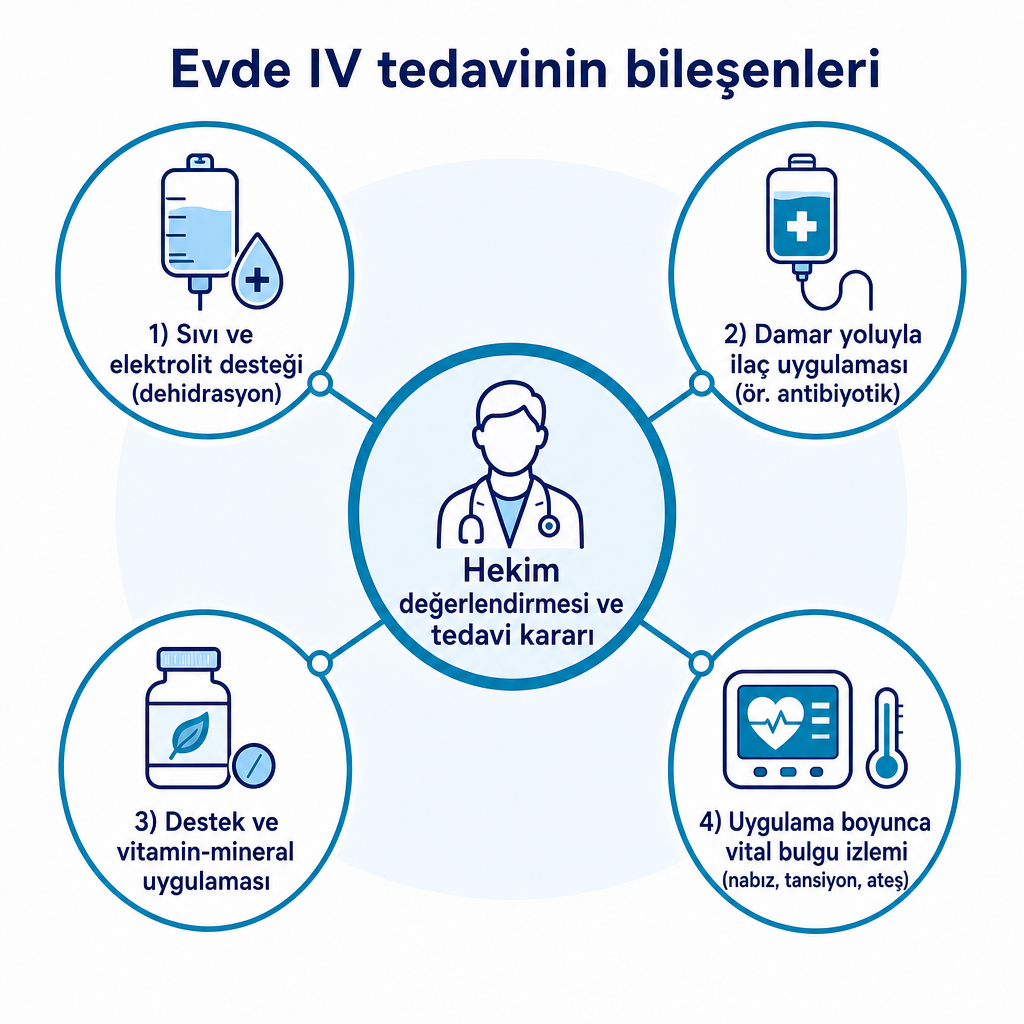
After the vein access is opened, the fluid advances at a determined rate with the help of gravity or a pump. Throughout the application, monitoring the patient's pulse, blood pressure, and general condition at an appropriate clinical level is an inseparable part of the treatment. Monitoring is not just waiting for the fluid to finish; it is observing the body's response to the application to detect a possible problem early.
Differences between serum types and clinical scenarios
"Serum" does not refer to a single thing. This word, commonly used among the public, actually encompasses many different fluids and treatments given through the vein. What distinguishes them is the content of the fluid and which medical purpose it serves.
Fluid and electrolyte support. In its most basic form, serum is aimed at reestablishing the fluid and salt balance that the body has lost. Such applications come to the agenda in cases of dehydration due to diarrhea, vomiting, high fever, or insufficient fluid intake. General sources list the replacement of fluid loss as one of the most common indications for home IV treatment.
Intravenous medication administration. Some medications, especially certain types of antibiotics, need to be given through the vein to work effectively. These treatments prescribed by the physician require administration at regular intervals and with the correct dosage; this makes professional nursing follow-up mandatory.
Support and vitamin-mineral applications. In cases deemed appropriate by the physician, vitamin or mineral supplements can also be given through the vein. The point to note here is that such applications are also made not by personal preference, but based on medical indication. What the content will be and whether it is necessary again depend on the physician's decision.
These types gain meaning together with the patient profile. Elderly individuals with mobility limitations, those with chronic illnesses, and patients requiring medical follow-up in the postoperative period are the groups for which home serum administration is most often considered. For these individuals, transportation to the hospital each time can itself become a burden; when the physician deems it appropriate, continuing treatment at home can contribute to the uninterrupted progress of care. The determining factor here is not comfort but medical suitability; comfort is only a side benefit that comes into play when the physician's decision medically permits it.
Why safety and hygiene stand at the center of this service
Opening a vein access is a procedure that temporarily bypasses the body's natural protective barrier. For this reason, protection from infection is not a technical detail of home serum administration, but precisely its essence. General medical sources define the syringes, needles, serum bags, and connection sets used in the application being single-use and sterile as a determining factor in reducing the risk of infection.
The approach we call aseptic technique is based on several complementary principles: washing the hands appropriately before the application, using disposable gloves, cleaning the vein area with an antiseptic solution, and properly disposing of the materials used after the procedure. These principles do not require the patient to make any extra preparation; ensuring the suitability of the environment and the sterile workflow is the responsibility of the professional team carrying out the application. You can also see the counterpart of the same hygiene logic in a different application area in our home wound care service and infection prevention content; both services draw on the same sterile working discipline.
The second pillar of safety is clearly knowing the possible complications. Sources state that risks such as infection, the needle entering the wrong vein, vein blockage, allergic reactions, and dosage errors may be involved in home IV treatment. It would not be correct to claim that these risks are completely eliminated; it can be said that they can be reduced with correct technique, appropriate equipment, and experienced personnel. Therefore, short-term clinical observation is recommended especially during the first applications, and consulting a physician in case of unexpected reactions.
It is at this point that the difference of home application from the hospital environment becomes evident. The home can provide a comfortable space for treatment; however, it carries logistical limitations in terms of situations requiring acute and rapid intervention. For this reason, it is important that the home serum service be planned with a structure that can arrange physician consultation in case of complications and, when necessary, hospital referral. In our working model, medical evaluation based on a 24-hour basis and transfer support when necessary are part of this whole; the aim is to keep the limit at which treatment remains sustainable at home under the physician's supervision.
Serum is not a "rest supplement," but a medical application based on the physician's decision; what determines its safety is who applies it, with what materials, and under what monitoring.
Evaluation criteria for patients and their relatives
As a patient's relative, the criteria that can be considered when evaluating the question "can we have serum administered at home?" are decision criteria rather than a step-by-step instruction. Clarifying these prevents both unnecessary worry and underestimation.
Medical necessity comes first. Whether home serum is appropriate is determined by considering the patient's clinical condition, mobility limitations, accompanying illnesses, and emergency risk. Since symptoms can vary from person to person, this decision belongs to the physician. The appropriate starting point is for the treatment to be recommended not by the person themselves, but by the physician who evaluates the patient.
The competence of the person administering is determinative. General sources highlight the serum administration being done by a licensed nurse or physician and the service being carried out through Ministry of Health-approved organizations as a critical criterion. When evaluating a home care organization, asking about the license status of the personnel who will carry out the application and whether the institution is licensed is a reasonable start.
Complication management should be questioned. A good evaluation is not limited to just the question "is serum administered?"; it also covers how physician consultation is provided in case of an unexpected reaction and how hospital transfer is organized when necessary. A structure with an emergency plan forms the safe framework of home IV treatment.
Clarity of monitoring and communication should be sought. It is important for patients' relatives to know in advance to whom and how they will report an unexpected finding during and after the application. The communication channel being open provides quick and correct guidance in a moment of concern. For those who want to see the nursing dimension of home serum in more detail, our home private nursing service page fully addresses the application and follow-up framework.
These criteria are not a ranking or priority list; together, they form a picture that shows whether home application is suitable and safe for the patient. A common misconception is the idea that serum alone is an application that "gives strength" or "relieves fatigue." The common emphasis of the sources is the opposite: serum is a form of treatment based on medical indication and the physician's decision.
The process's relationship with the whole of home care
Home IV drip service is not a standalone procedure; it is part of the whole formed by home physician care, nursing, and other care services when necessary. The need for serum often arises within a broader picture: in situations such as postoperative recovery, management of a chronic illness, or age-related fluid and nutrition difficulties, treatment is not limited to a single application.
Within this integrity, the physician creates the diagnosis and treatment plan; the nurse implements the plan and monitors the patient; when necessary, different disciplines complete the process. For example, in the postoperative period, when regaining mobility along with IV treatment becomes important, home physiotherapy service becomes another link of the same care plan. The strength of home care comes not from individual procedures, but from connecting these procedures with the same team understanding.
In this framework where the evaluation and treatment decision belong to the physician, the correct starting point is often an examination and clinical evaluation. You can find more detailed information about the need for serum being evaluated by the physician and continued with home nursing application on our all our home care services page, where you see our home physician and nursing services together. We can clarify the appropriate evaluation path together according to your patient's condition, diagnosis, and the region they live in.
Frequently Asked Questions
Why is a physician evaluation required for home serum administration?
Because the content, dosage, and administration rate of the serum are determined according to the patient's medical condition. The physician decides whether the application is appropriate after evaluating the patient's past illnesses, current condition, and possible allergies. Applications made without a prescription and medical evaluation are considered problematic both in terms of safety and legally.
Is home serum administration safe?
General sources state that home serum administration can be done safely with appropriate patient selection, licensed health personnel, and the use of single-use sterile materials. However, risks such as infection, allergic reaction, or dosage error cannot be completely eliminated; these risks are attempted to be reduced with correct technique, appropriate monitoring, and a hospital referral mechanism when necessary.
Who decides on the serum content?
The content decision belongs only to the physician. Which of the options such as fluid and electrolyte support, intravenous medication, or support applications is appropriate is determined based on medical indication. Serum administration upon personal request, without medical necessity, is not a recommended approach.
What is monitored during home serum administration?
Throughout the application, the patient's vital signs such as pulse, blood pressure, and temperature are expected to be monitored at an appropriate clinical level. Short-term observation is recommended especially during the first applications, and consulting a physician when an unexpected finding arises. Monitoring is an inseparable part of the treatment in order to detect a possible problem early.
For which patient groups is home serum administration considered?
It generally comes to the agenda for elderly individuals with mobility limitations, those with chronic illnesses, and patients requiring medical follow-up in the postoperative period. Nevertheless, the physician decides whether it is appropriate for each patient, taking into account the clinical condition and emergency risk.
What can be looked at when evaluating a home care organization?
The organization being licensed by the Ministry of Health, the personnel carrying out the application being a licensed nurse or physician, the use of sterile single-use materials, and the presence of a structure that can arrange physician consultation and hospital referral in case of complications are technical criteria that can be evaluated.