Home private nursing service is the provision of medical and psychosocial care planned according to need, in line with the physician's plan, by a licensed nurse who visits the patient at their own home or living environment at regular intervals. It is the nursing component of the home healthcare ecosystem; it encompasses roles such as monitoring vital signs, administering medications, wound care, and educating the family on care.
This definition, independent of institutions' own narratives, appears similarly in sources that categorize home care services into professional disciplines. Nursing service is defined as the professional healthcare that nurses provide according to need by visiting the person at home at certain intervals. With our Üsküdar-based team, we carry out this service as part of a holistic home care model, within the same organization as home physician care and physiotherapy.
Contents
What home private nursing service means and how it works
Every type of healthcare received at home is generally gathered under the heading of home healthcare service; it is a model that enables a person to receive care in their own living space during post-diagnosis treatment, chronic disease follow-up, and rehabilitation processes. Within this broad framework, nursing service is the component in which clinical applications are carried out by a nurse.
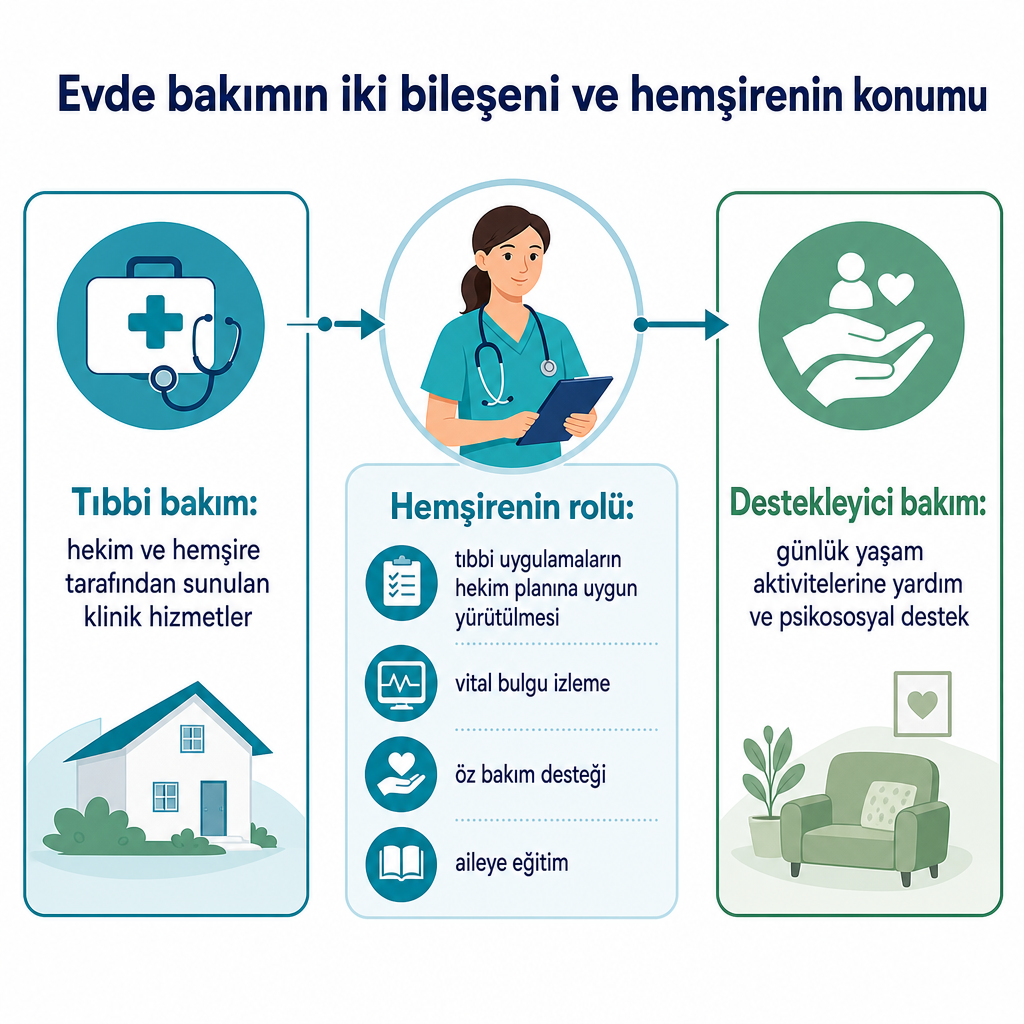
At the center of the process lies a distinction: home care services consist of two main components, medical care and supportive care. Medical care covers the clinical services provided by healthcare professionals such as physicians and nurses; supportive care covers assistance with daily living activities and psychosocial support. Home private nursing service builds a bridge between these two areas: it both carries out medical procedures and helps the patient and family understand the care process.
The nurse's role at home is not limited to a single procedure. In the general framework, the home care nurse has roles such as carrying out medical procedures at home in accordance with the physician's plan, monitoring vital signs, supporting the patient's self-care skills, and educating the family on care. This explains why the service is carried out according to a plan: every medical procedure performed has an indication and a medical responsibility.
In our model, this process works in coordination with physician care. Home private nursing service is often framed by a physician evaluation; the patient's condition, the follow-up to be carried out, and the decision to transition to other services when necessary are connected to this medical plan. Because our team includes a licensed physician, nurse, and physiotherapist working together, nursing follow-up is not an isolated service but a link in the medical chain within the same organization. We address the details of nursing roles more concretely in our guide titled home care nurse's duties and selection criteria.
Types of home nursing service and how they differ
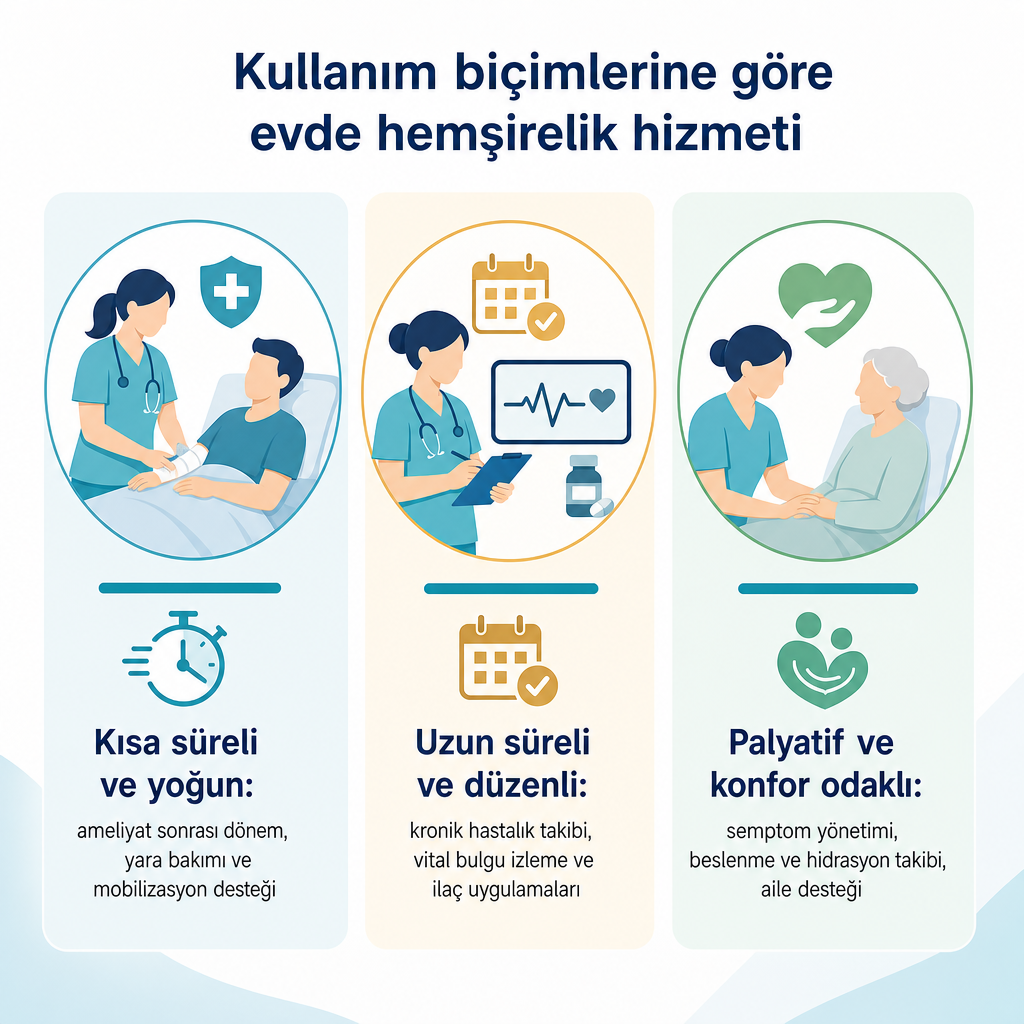
Home nursing service does not fit into a single mold; the duration, intensity, and purpose of the need give rise to different forms of use. The fundamental axis that distinguishes these forms from one another is how long the care lasts and which clinical purpose it serves.
Short-term and intensive use is mostly associated with an acute period. Wound care, dressing, mobilization support during the post-operative recovery process, and continuing the check-ups recommended by the physician at home are examples of this group. Here, the aim is to safely get through a specific recovery period; the service can end once recovery is complete.
Long-term and regular use is associated with chronic conditions and advanced age. In cardiovascular, respiratory, neurological, or metabolic diseases, long-term medication follow-up, vital sign monitoring, lifestyle compliance, and early detection of possible complications come to the forefront. Here, nursing visits are planned at regular intervals on the basis of continuity.
The palliative period and comfort-focused care is a third form of use. Symptom management, comfort-focused care, nutrition and hydration monitoring, and involving the family in the care process are the predominant topics of this period. The aim of care shifts from recovery toward preserving quality of life.
Another distinction relates to at which part of the day and at what intensity care is provided; planned visits made at certain hours and situations requiring more intensive accompaniment require different planning. Knowing these differences conceptually is important, because even for the same patient the need may change over time: an intensive post-operative period may turn into more infrequent chronic follow-up in the following weeks.
In our service portfolio, these needs are not addressed in isolation. Clinical topics such as home wound care, serum and IV applications, and palliative care overlap with the different forms of use of nursing service. For example, while wound care comes to the fore in the post-operative period, vital sign monitoring and medication applications may be determining in chronic follow-up. To see how these clinical topics form a whole, you can review the scope of our home private nursing service.
In which situations it comes into play and why it matters
Home nursing service usually begins with a question: the patient needs regular clinical follow-up, but every trip to the hospital or clinic is difficult, risky, or tiring. In the general framework, home care and home healthcare services are aimed at meeting the needs of elderly, chronically ill, mobility-restricted individuals, those in the post-operative recovery period, or those in the palliative care process in the home environment. This description also shows in which situation the service becomes meaningful.
Mobility restriction or being bedbound is one of the most frequently encountered contexts. In patients who find it difficult to leave home or whose transfer is difficult or risky, bringing regular clinical follow-up home both preserves medical continuity and reduces the burden on the patient. In chronic diseases, long-term medication follow-up and complication monitoring can become more consistent with regular visits.
In the post-operative period, the importance of the service relates to getting through the critical days of recovery in a planned manner. Carrying out wound care and mobilization support in line with the physician's recommendations contributes to this period passing safely. In palliative care and advanced age, the focus is on managing symptoms and preserving quality of life.
The importance of this service for families often emerges in a frequently overlooked aspect: the care burden. Professional nursing support takes the responsibility of monitoring the medical process off the shoulders of family members alone and involves the family in the care process with correct information. One of the nurse's roles is precisely this; to inform the patient and family on topics such as medication use, nutrition, mobilization, and pressure ulcer prevention, and to involve the family in the process.
At this point, a common misunderstanding needs to be corrected. Home nursing service does not transform the home into a hospital environment and does not meet every clinical need in home conditions. In situations requiring advanced intervention, a hospital environment is necessary; home nursing enables clinical follow-up in accordance with the physician's plan and the continuation of certain applications in the home environment. Being aware of this boundary is the basis for planning with the right expectations. Indeed, we also carry out topics such as emergency situation assessment and support for the hospital transfer process when necessary, considering these boundaries of home care.
Criteria to consider when evaluating
When evaluating home nursing service, a framework of questions works better than a list of procedures. The following headings provide a basis for the questions you can direct to your physician and to the institution from which you will receive the service.
Institutional structure and licensing is the first criterion. In Turkey, home health and care services are carried out with a license within the framework of the Ministry of Health legislation; it is essential that physicians, nurses, and other professionals provide services within a legal and ethical framework. Whether a center operates within this framework is the foundation of the service's reliability. We provide this service as a home care center licensed by the T.R. Ministry of Health.
Physician-nurse coordination is the second criterion. Carrying out home nursing service in accordance with a physician evaluation and medical plan ensures that medical responsibility stands in the right place. A structure that can be supported by our home doctor examination and physician service when necessary allows nursing follow-up to operate not alone, but as part of a medical chain.
The clarity of the service scope is the third criterion. Which medical procedures the nurse undertakes, in which situations the physician will be informed, and in which cases a transition will be made to other services such as physiotherapy or palliative care must be agreed upon in advance. Ambiguity of scope later leads to a mismatch of expectations. For example, in a patient with mobility restriction, knowing whether home physiotherapy support can be brought in alongside nursing follow-up sets up the planning correctly from the start.
Duration and frequency is the fourth criterion. Short and intensive periods such as post-operative recovery and long, regular periods such as chronic follow-up require different planning. How the service describes these different models shows whether an arrangement suitable for your need can be created.
Infection control and safety is the fifth criterion. When performing medical procedures at home, hygiene, sterility, the safety of the materials used, and waste management are important. In addition, medication safety, applying invasive procedures with the correct indication and technique, and managing fall and pressure ulcer risks are also among the safety topics. How these matters are addressed directly affects the quality of care.
Communication and education is the sixth criterion. The nurse informing the patient and family on topics such as care processes, medication use, nutrition, and mobilization increases the sustainability of care. A good home care process rests on a structure that guides the family rather than leaving it out.
Because symptoms and clinical needs vary from person to person, which form of use and scope is appropriate is determined by a physician evaluation. These criteria are a framework that helps you ask the right questions before making a decision; they are not a definitive prescription for selection.
Your next step after being informed
When you understand home private nursing service as a whole, the decision ahead of you becomes clear: to evaluate whether the need is short-term or continuous, which clinical topics come to the fore, and how the physician evaluation will be positioned. Since this evaluation is personalized according to the patient's condition, the healthiest path is to address the concrete need together.
If you would like to see the scope of the service and our approach in more detail, you can review the page of our home private nursing service and our services page where you can see all clinical topics together. When you inform us about the patient's condition, the duration of the need, and the priority clinical topics, we can prepare a planning proposal suitable for the situation.
Frequently Asked Questions
What exactly is home private nursing service?
It is the provision of medical and psychosocial care according to need, in line with the physician's plan, by a licensed nurse who visits the patient at their own home at regular intervals. It is the nursing component of home healthcare services, covering roles such as monitoring vital signs, administering medications, wound care, and educating the family on care.
Are home nursing service and home care the same thing?
They are not exactly the same. Home care is a broader umbrella and consists of two components: medical care and supportive care. Home nursing service is the part that carries out the medical and clinical aspect of this umbrella with the nursing discipline; it also includes supportive roles directed at the patient and family.
Is nursing service carried out without a physician?
The service operates within a framework in which medical responsibility lies with the physician. The procedures performed are subject to a physician's plan and indication. In our model, home nursing is part of a holistic structure that is supported by home doctor examination when necessary, and in which a licensed physician, nurse, and physiotherapist work within the same organization.
In which situations does home nursing come into play?
In the general framework, it comes into play in the regular clinical follow-up of elderly individuals, those with mobility restrictions, those with chronic diseases, those in the post-operative recovery period, or those in the palliative care process. Which form of use is appropriate varies from person to person, and consulting a physician is recommended for evaluation.
Does home nursing service replace hospital care?
It does not meet every clinical need in home conditions. In situations requiring advanced intervention, a hospital environment is necessary. Home nursing enables clinical follow-up in accordance with the physician's plan and the continuation of certain applications in the home environment; being aware of this boundary is the basis for planning with the right expectations.
How is safety ensured when performing medical procedures at home?
Hygiene and sterility, the safety of the materials used, waste management, medication safety, applying invasive procedures with the correct indication and technique, and managing fall and pressure ulcer risks are the fundamental safety topics. How these topics are addressed directly determines the quality of care provided at home.