The short answer to the question of what home nursing service is: it is the professional care and medical procedures provided by nurses in their own living space to individuals who have difficulty going to the hospital or whose medical follow-up is maintained in a home setting. This service is not an independent practice; it is based on the diagnosis made by the physician and the treatment plan they establish. According to this plan, the nurse carries out the nursing interventions that are appropriate to perform at home, monitors the patient, and shares the findings with the physician. Thus, the treatment and care process that begins in the hospital can continue in a familiar environment to the extent deemed appropriate by the physician.
In the following sections, we present the definition of the service, its scope, the legal framework in Turkey, the situations in which it arises, and what is taken into account in the decision-making process within an informative framework.
Table of Contents
What exactly does home nursing service cover?
A home nurse is a healthcare professional who performs nursing care and medical procedures in the home setting for individuals of different age groups and disease types. The content of the service is not tied to a single template; it is shaped according to the patient's clinical condition, the physician's treatment plan, and the job descriptions defined by legislation. Making the areas of application concrete also clarifies the boundaries of the service.
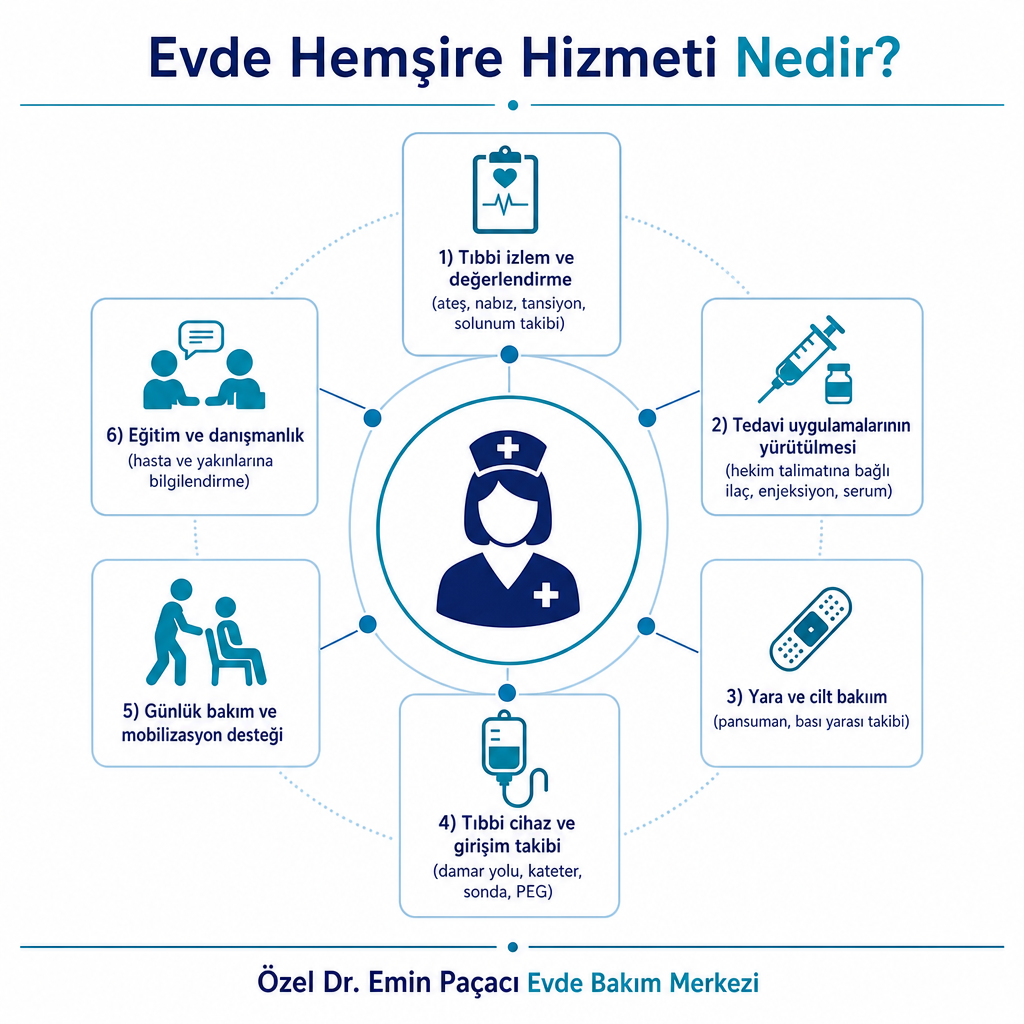 The main areas of home nursing service
In general, home nursing may include the following areas:
- Medical monitoring and evaluation: Monitoring of vital signs (temperature, pulse, blood pressure, respiration), observation of general condition, and sharing findings with the physician.
- Carrying out treatment procedures: Administration of medications, injections, and serum therapies planned and specified in writing by the physician, performed in the home setting.
- Wound and skin care: Nursing interventions such as post-surgical wound care, dressing, and the monitoring and care of pressure sores (bedsores).
- Medical device and intervention monitoring: Care and monitoring of interventions such as IV lines, catheters, tubes, and PEG; carrying out the necessary checks according to the physician's plan.
- Daily care and mobilization support: Personal care applications when needed and support for the mobilization process under the guidance of the physician or physiotherapist.
- Education and counseling: Providing information to the patient and their relatives, within the limits set by the physician, about the care process and points to be considered.
These applications are planned within the framework of the nurse's professional competence and the relevant legislation; in accordance with physician instructions and institutional protocols. Whether nursing interventions can be sustained at home is also part of this evaluation. Decisions that go beyond the applications included in the treatment plan are the responsibility of the physician following the patient.
Legal framework in Turkey and ways the service is provided
In Turkey, home care and home health services are defined by regulations published by the Ministry of Health. This legislation determines to whom, according to which standards, and with what assurance the service will be provided. Several principles stand out as important from the reader's perspective.
Home health service covers the provision of medical services that can be performed at home—according to certain standards—to individuals determined to need health care in the place where they live. Within the home health team, nurses carry out treatment and care procedures based on physician instructions; obtaining written and signed physician instructions for these procedures is mandatory. This requirement is the fundamental assurance that distinguishes nursing practice performed at home from an arbitrary intervention.
The channels through which the service can be provided are also determined by legislation. Home care and home health services may be provided by public institutions, university hospitals, and licensed private organizations, in accordance with the conditions specified in the legislation. In addition, matters such as recording nursing services, patient safety, infection control, the use of appropriate equipment, and referral processes to higher-level health institutions when necessary are regulated in detail. You can review these regulations on the Ministry of Health's regulation page on the provision of home care services and in the relevant legislative text.
For those curious about the place of home nursing within the broader framework of home care, we have compiled the basics of home care service in a separate article.
In which situations might home nursing come into consideration?
Home nursing is not a standard requirement for every individual; it is evaluated as an option that varies according to clinical condition, functional capacity, and treatment plan. In various sources and legislation, the need for home nursing is mentioned in the following situations:
- Individuals who are bed-bound or home-bound and have a chronic illness (for example, long-term heart, respiratory, or neurological diseases).
- Elderly individuals who cannot carry out daily living activities on their own and need care support.
- Patients who are planned to be monitored at home for a certain period after a surgical intervention; whose wound care, mobilization, and treatment applications need to be continued at home.
- Patients who have long-term medical interventions (feeding tube, tracheostomy, catheter, IV line, etc.) and require regular monitoring.
- Patients in the palliative care process, whose pain, nutrition, and basic care needs are monitored at home.
In these situations, whether there is a need for home nursing service is usually evaluated by the physician following the patient and the relevant healthcare team. Since symptoms and needs vary from person to person, the physician's decision is decisive in choosing the appropriate type of service. For example, home monitoring after orthopedic surgery has a particular importance in processes such as the points to consider at home after prosthesis and similar interventions. The guide to adapting to the home care process after intensive care, aimed at families of patients discharged from intensive care, is also an informative resource regarding this transition period.
How the service works and the points to consider
The basic operation of home nursing service is based on the coordination of physician evaluation and the nursing care plan. Knowing how the process is structured also clarifies what families should expect.
Medical evaluation and planning: The diagnosis, treatment goals, and suitability of home care are determined by the physician. The nursing interventions to be performed at home are clarified with written instructions and a care plan.
Evaluation of the home environment: The suitability of the care environment in terms of hygiene, safety, and equipment is evaluated within the framework of the institution and legislation. The placement of the patient's bed, mobilization area, and medical supplies is arranged in a way that allows the nurse to perform safe applications.
Regular visits and monitoring: The frequency of visits can be planned at hourly, daily, weekly, or longer intervals depending on the treatment applied and the care need. The procedures performed and observations made at each visit are recorded; when necessary, the plan is updated by communicating with the physician.
Patient safety and risks: In every medical procedure performed at home, the risk of infection, possible side effects associated with medication administration, and the possibility of complications related to medical devices are taken into account. Legislation and institutional protocols contain detailed rules on matters such as hand hygiene, the use of single-use materials, safe medication administration, and the paths to follow in emergencies.
In reducing risks, the nurse's clinical experience, regular record keeping, continuous communication with the physician, and the decision to refer to hospital conditions when necessary are important. These decisions are made by the physician following the patient and the healthcare team.
Key differences between public and private services
In Turkey, it is possible to access home health and nursing services through three main channels: home health units affiliated with the Ministry of Health, home care units of university and public hospitals, and licensed private organizations.
Public home health units evaluate individuals who need home health service according to the criteria defined in the regulation; regular visits with a physician, nurse, and other team members can be planned for those found suitable. Private organizations, on the other hand, organize physician and nursing services according to their own operations while complying with the licensing conditions within the scope of the same legislation.
The physician and family can decide together on which channel is appropriate, taking into account the patient's medical condition, the accessibility of public services in the region where they live, and the nature of the care need. This preference is a matter evaluated separately for each patient.
The place of home nursing service at our center
As Private Dr. Emin Paçacı Home Care Center, we are a Ministry of Health-licensed home care organization operating in Üsküdar, Istanbul. We provide home health and care services with teams composed of physicians, nurses, and physiotherapists.
Our home private medicine service includes applications such as physical examination and general evaluation, diagnosis and treatment planning, chronic disease monitoring, palliative care, and home serum therapy. Within this scope, in cases deemed appropriate by the physician, home nurse support can be provided so that the nursing interventions included in the treatment plan can be applied in the home setting.
Our home private nursing service refers to the professional nursing support aimed at continuing the care and treatment process planned by the physician in the home setting, within our patient-focused approach. The content and frequency of nursing care are evaluated together by the physician and nurse in line with the patient's clinical condition, functional capacity, and current treatment plan. For patients who need physiotherapy, home physiotherapy support can be planned within inter-team coordination.
Decision-making process: is home nursing appropriate?
The suitability of home nursing service is a clinical decision that must be evaluated individually. The following headings are generally taken into account in this decision:
- The patient's diagnosis, the course of the disease, and medical needs
- The patient's level of mobility, self-care skills, and degree of home- or bed-dependency
- Whether the current treatment can be safely continued at home
- The suitability of the home environment in terms of hygiene, safety, and equipment
- The family's or caregivers' opportunities to participate in the care process
Since symptoms and needs vary from person to person, it is recommended that the decision between options such as home nursing, home health, or the hospital environment be made after a medical evaluation carried out by the physician. For your questions regarding the care process, sharing information such as your patient's clinical condition, current treatment plan, and your location helps in providing information appropriate for you.
Frequently Asked Questions
Are home nursing service and home health service the same thing?
Home health service is a broader framework that includes physicians, nurses, and other healthcare professionals. It covers preventive health, diagnosis, treatment, care, and rehabilitation services for individuals who are home-bound due to diagnosed illnesses. Home nursing service, on the other hand, refers to nursing care and applications within this framework.
Who plans the home nursing service?
The nursing applications to be performed at home are evaluated medically by the physician following the patient and planned with written instructions. In line with this plan, the nurse carries out the care and treatment applications; they regularly report the findings and developments to the physician.
How long do home nurse visits last and how often do they occur?
The duration and frequency of visits vary depending on the nature of the procedures to be performed, the patient's clinical condition, and the treatment plan. In some cases, short-term daily visits may be needed, while in others, less frequent but long-term checks may be required. This plan is determined together by the physician and nurse.
What procedures can a home nurse perform?
A home nurse can perform nursing interventions such as injection and serum applications, wound and dressing care, bedsore monitoring, care of certain catheters and tubes, vital sign monitoring, and care counseling, based on the physician's plan. The type and scope of the application are determined according to legislation and institutional protocols.
Who should be consulted first for home nursing service?
In cases where a need for home health or home nursing is suspected, it is recommended to first consult the physician following the patient or the family physician. After the clinical condition is evaluated and the appropriate type of service is determined, home health and nursing services can be planned through public or private channels.