Home physiotherapy service is a healthcare service carried out by physiotherapists that enables individuals experiencing loss of movement and function to continue their rehabilitation process in the home environment. Within the framework of the physician's assessment and the physiotherapist's individualized plan, it is applied to support movement, balance, and independence in daily life in cases of chronic illness, the post-surgical period, or age-related limitations.
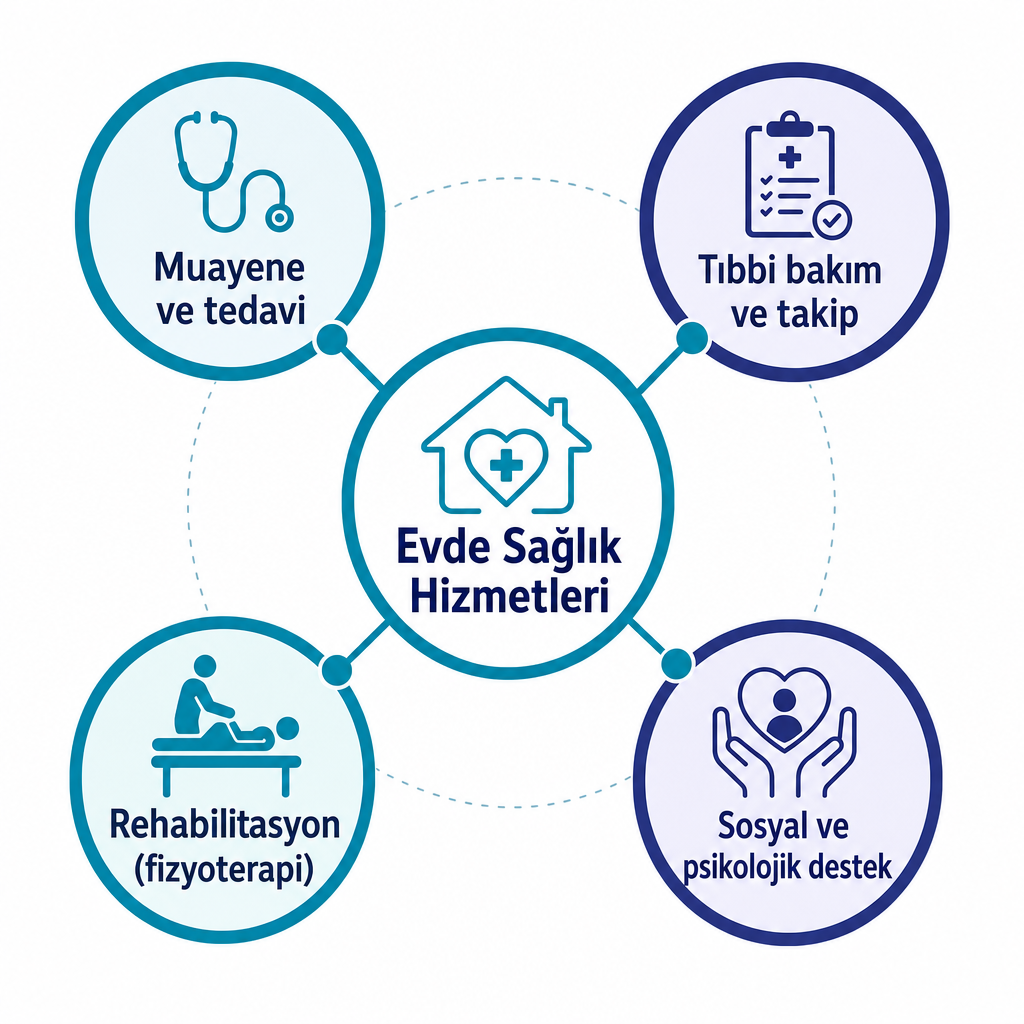
In Ministry of Health resources, home healthcare services are defined as the provision of examination, treatment, medical care, follow-up, and rehabilitation components as a whole in the home environment. Within this definition, physiotherapy corresponds to the rehabilitation component. As the Private Dr. Emin Paçacı Home Care Center, we also approach home physiotherapy as a team service in which the physician and physiotherapist work together, situated within the Ministry of Health-licensed home care framework.
Contents
What is home physiotherapy service and what role does it play in rehabilitation?
Home physiotherapy is the carrying out of rehabilitation work in the environment where the patient lives, without going to a facility. The fundamental difference here is not merely a change of environment: The physiotherapist works by seeing the patient's real daily living conditions. Activities such as getting out of bed, sitting, reaching the bathroom, and walking down the hallway are addressed based on the actual thresholds, distances, and floor conditions in the person's home.
According to the Ministry of Health definition, home healthcare services are a service in which examination, examination, treatment, medical care, follow-up, and rehabilitation, as well as social and psychological support, are provided as a whole. Within this framework, physiotherapy is not a standalone application but the component of the rehabilitation process brought into the home environment. For a detailed definition, the Republic of Türkiye Ministry of Health Home Healthcare Services page is an official resource that can be consulted.
Mechanically, the process is built upon a plan that begins with the physician's assessment. The physiotherapist observes the patient's current functional status, difficulties in daily living activities, balance, strength, and range of motion, and creates an individualized work program based on this assessment. The goal is generally to preserve or increase functional capacity, to remain as independent as possible in daily life, and to support safe movement. Goals are determined together according to the diagnosis and clinical condition; they vary from individual to individual.
For whom can home physiotherapy be considered?
Home physiotherapy comes into consideration for people for whom reaching a healthcare institution is physically difficult or risky, yet who still need the rehabilitation process. The following situations are the main scenarios in which this service is frequently considered. In every case, whether home physiotherapy is appropriate varies from person to person; the assessment and treatment decision belongs to the physician.
- Restricted movement and mobility issues: Individuals of advanced age who experience difficulty walking, climbing stairs, or getting out of bed; patients with reduced muscle strength due to prolonged bed rest.
- Post-paralysis / post-stroke period: Rehabilitation aimed at restoring movement, balance, and daily living activities in people with loss of strength on one half of the body.
- Post-orthopedic surgery process: Supporting functional recovery in the period following hip or knee replacement surgery, major fractures, or surgery.
- Chronic neurological diseases: Work aimed at movement, balance, and coordination in diagnoses such as MS, Parkinson's, dementia, or cerebral palsy.
- Long-term illness and palliative care: Preserving or supporting as much as possible functional independence in people who have become bed-bound or home-bound.
These scenarios show "who" home physiotherapy addresses; however, a diagnosis appearing on the list does not mean it is automatically appropriate for that patient. The physician and physiotherapist assessing the patient together determine which approach is meaningful in which situation.
How is home physiotherapy integrated into the home care team?
Considering home physiotherapy not as a standalone application but as part of a team service is also at the core of the official home health definition. In the Ministry's definition, examination, treatment, medical care, follow-up, and rehabilitation are planned together. In practice, this means coordination among the physician, physiotherapist, and nurse.
The process usually begins with a physician assessment. Within the scope of our home private medicine service, the patient's clinical condition is assessed and the medical framework for the rehabilitation goals is determined. The physiotherapist creates an individualized plan within this framework and provides regular feedback. When necessary, elements such as monitoring vital signs, administering medication, wound care, or nutrition–hydration follow-up can be carried out simultaneously with our home private nursing service. Thus, rehabilitation ceases to be work disconnected from the patient's overall medical condition.
The home environment has both advantages and limitations in this scenario. On the advantage side, the work being done in the patient's real living space and the family being able to directly witness the process stand out. When the caregiver can carry the physiotherapist's recommendations into the daily routine, the process becomes more continuous. On the limitation side, the physical conditions of the home (narrow walking area, stairs, bathroom–toilet layout) can affect the scope of the work. These conditions are factors that directly determine how the plan will be structured.
The fact that a home care center offers a physician, nurse, and physiotherapist under the same roof makes it more visible why this coordination is important. Our article the importance of Ministry of Health-approved home care, which addresses in detail the role of the legal framework and team structure in the quality of care, offers complementary reading on this subject.
What should be considered when deciding on home physiotherapy?
When evaluating home physiotherapy, a few concrete criteria help establish the decision soundly. These are not a ranking but conditions weighed together.
| Assessment area | Points to consider |
|---|
| Transportation and physical burden | Is going to the healthcare institution physically difficult or risky for the patient? |
| Suitability of the home environment | Are the walking area, stairs, sitting/standing points, and bathroom layout suitable for the work? |
| The caregiver's role | Can family members accompany the recommendations and adapt them to daily life? |
| Clinical coordination | Has the plan been assessed by a physician, and does the physiotherapist provide regular feedback? |
| The center's legal status | Is the center Ministry of Health-licensed; are the physician, nurse, and physiotherapist together? |
The common aim of these criteria is to see how well home physiotherapy aligns with the patient's real condition and environment. For example, if the transportation difficulty is significant but the home environment is suitable for the work, it may be meaningful to discuss home rehabilitation with the physician. Conversely, if the patient's clinical condition requires more intensive institutional follow-up, the physician may recommend a different path.
In Türkiye, home healthcare services are also provided through Home Healthcare Service Units within public hospitals. Private home care centers, on the other hand, are institutions that are licensed by the Ministry of Health and provide services with their own teams. The choice between these two options is evaluated in line with the patient's needs and the physician's recommendation.
Expectation management is also part of the decision criteria. Session duration and frequency are determined not by a standard number but according to the diagnosis, functional condition, and the physician's recommendation. Keeping goals realistic and appropriate to the medical framework is important for the process to progress soundly. For this reason, expectations must definitely be clarified by discussing them together with the physiotherapist and physician.
Next step: Planning the home physiotherapy process
Once what home physiotherapy is, whom it addresses, and what team framework it fits into become clear, the next question is usually how the process will be initiated. At this point, the assessment and treatment decision belongs to the physician who sees the patient; the first step is for the person's clinical condition to be addressed by a physician.
To see the entirety of our service scope and how home physiotherapy relates to other home care services, you can review our services page; you can contact us to determine the appropriate framework according to the patient's diagnosis, current functional condition, and home conditions. Once the patient's condition and expectations are shared, we can evaluate together how home physiotherapy can be planned.
Frequently asked questions
Is home physiotherapy different from clinical physiotherapy?
The basic rehabilitation logic is the same; the difference is that the work is carried out in the patient's own home environment. This allows the physiotherapist to plan by seeing the real daily living conditions. Which one is appropriate is evaluated by the physician according to the person and the clinical condition.
Who can benefit from home physiotherapy?
Movement restriction due to advanced age, the post-paralysis/post-stroke period, the post-orthopedic surgery process, chronic neurological diseases, and situations of prolonged bed rest are frequently evaluated scenarios. Suitability varies from person to person; the decision belongs to the physician.
What is the role of the physician and physiotherapist in home physiotherapy?
The physician assesses the clinical condition and determines the medical framework of the rehabilitation goals. Within this framework, the physiotherapist creates, applies, and provides regular feedback on the individualized work plan. When necessary, the process is coordinated with nursing follow-up.
How is home physiotherapy related to public home healthcare services?
In Türkiye, home healthcare services can be provided through both the Home Healthcare Service Units of public hospitals and Ministry of Health-licensed private home care centers. Rehabilitation is a component of the official home health definition.
How are session duration and frequency determined?
There is no standard number. Duration and frequency are determined individually according to the diagnosis, the patient's functional condition, and the physician's recommendation. Expectations should be clarified together with the physiotherapist and physician.