An in-home doctor's examination in Istanbul is a home healthcare service in which the physician comes to the patient's address and carries out the medical history, physical examination, and medical evaluation on site. It is a team-based care model designed for individuals who have difficulty reaching a hospital, who have a chronic illness, or who have limited mobility. In this article, we explain what the service is, in which forms it is applied, and which criteria can be considered when making a decision.
As a home care organization based in Üsküdar, we closely observe both the medical content and the everyday relevance of a physician's examination provided in the home environment. Our aim here is not to describe an appointment procedure; it is to offer an informative framework that will help the reader understand their own situation more clearly.
Table of Contents
What is an in-home doctor's examination, and what kind of healthcare service is it?
An in-home doctor's examination is a medical evaluation carried out in the patient's own living space. It follows the same clinical logic as an examination performed in an outpatient clinic setting; the difference is that the examination is brought to the patient's address instead of the patient being taken to the hospital. In Turkey, home healthcare is a model provided on the public side both by Ministry of Health units and by municipalities, in which the patient is evaluated at home and included in the service according to eligibility criteria; this can be seen on the Istanbul Metropolitan Municipality's home healthcare information page.
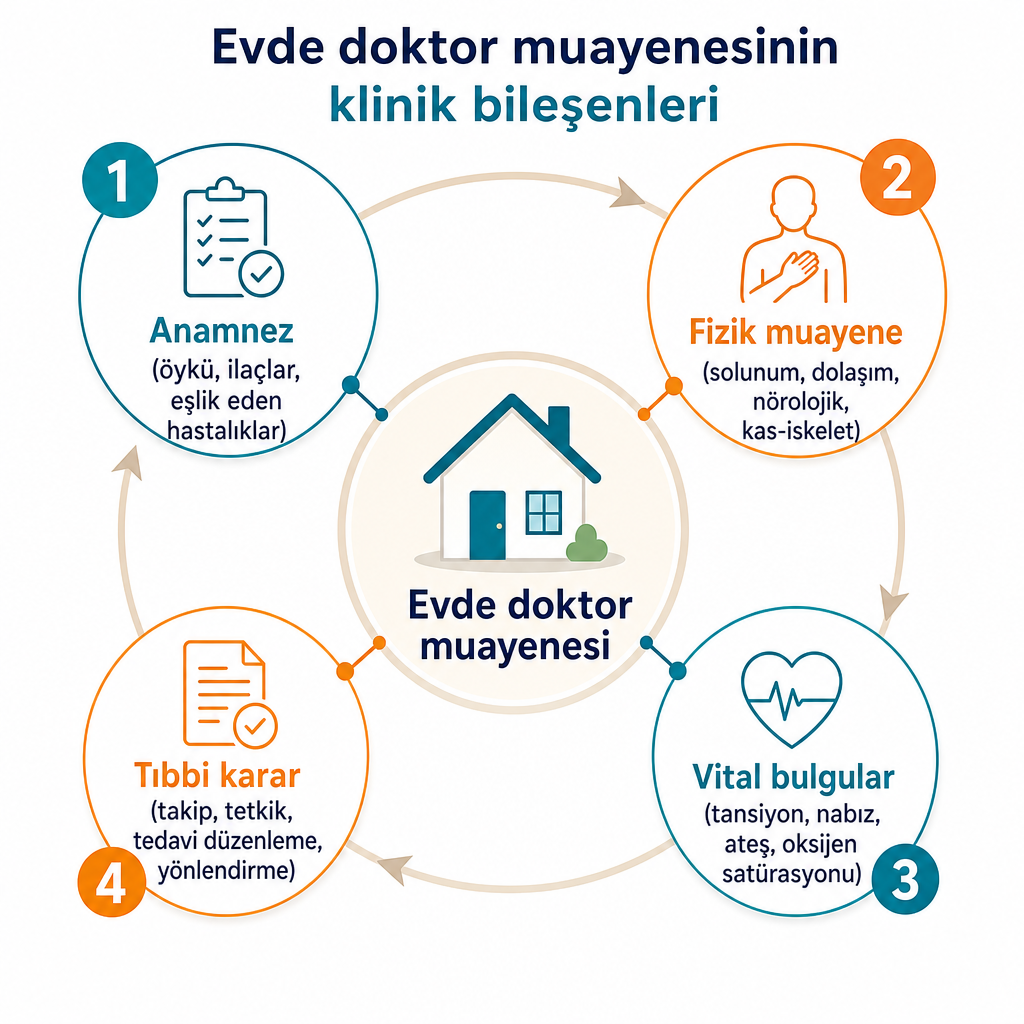
The medical content of the examination consists of several core components. The first stage is the medical history: the physician listens, on site, to the patient's current complaints, accompanying illnesses, the medications they use, and their past medical history. Then comes the physical examination; core systems such as the respiratory, circulatory, neurological, and musculoskeletal systems are evaluated with the help of portable medical equipment. Vital signs such as blood pressure, pulse, temperature, and oxygen saturation can be measured with mobile devices.
At the end of the evaluation, the physician forms a medical decision based on the findings obtained. This decision may be to continue home follow-up, to request additional tests, to review the treatment, or to plan nursing or physiotherapy support. When necessary for the patient's safety, referral to a relevant healthcare institution is also part of this decision. It is also explained in the home healthcare unit statement of a training and research hospital that, in the public model, applications are received through a central system and scheduled into appointments by coordination units.
In short, an in-home doctor's examination is a service in which diagnostic and clinical evaluation is brought into the home environment while losing none of its medical seriousness. The evaluation and treatment decision belong to the physician; because symptoms and findings vary from person to person, clarifying suitability is also possible only through a physician's evaluation.
Types and areas of use of in-home doctor's examinations in Istanbul
An in-home doctor's examination does not fit a single mold; it takes different forms according to the patient's clinical need. Knowing these differences makes it easier to assess whether an in-home examination is suitable for your own situation.
A one-time evaluation examination is performed to examine an acute complaint or the general condition on site. The aim here is to define the patient's current situation and, if necessary, to plan the next step.
Chronic disease follow-up comes into play in conditions requiring regular monitoring, such as heart failure, COPD, or neurological diseases. Such examinations are generally repeated at certain intervals and are based on observing the patient's course over time.
Post-operative check-up examinations are especially meaningful for patients for whom traveling may be inadvisable. For individuals who require close follow-up in the early period but for whom going back and forth to the hospital is challenging, an examination in the home environment contributes to monitoring the recovery process. We address this entire process in more detail in our post-operative home care guide.
The examination of bedridden and palliative care patients is arranged for individuals with multiple illnesses who are unable to move. In this group, the physician's examination often proceeds as part of a comprehensive care plan and is closely related to symptom management. We examine the practical dimensions of care for bedridden patients in our home care for bedridden patients article.
The examination of patients in the rehabilitation process is planned for individuals who need physician supervision together with home physiotherapy during a neurological or orthopedic recovery period. Here, the examination lays the groundwork for carrying out the physiotherapy plan within clinical safety.
What these areas of use have in common is that they all arise from a situation that makes reaching a hospital difficult. Public home healthcare statements also define the target group as individuals who have difficulty reaching a hospital, who are bedridden, who have a chronic illness, and who are of advanced age. Examination in the home environment aims to meet these needs under a single visit.
The relationship between the in-home doctor's examination and other home healthcare services
An in-home doctor's examination is often not a service that stands alone; it is the gateway to a broader care network provided in the home environment. The decisions the physician makes during the examination determine which additional supports will be activated, and at this point a multidisciplinary structure emerges.
When the physician recommends, as a result of the examination, medication or IV administration, wound and dressing care, or regular follow-up, the process integrates with nursing service. Our home private nursing service brings the clinical decisions of the examination to life through practices such as medication and IV administration, wound care, and general follow-up. Thus the examination is not limited to an evaluation but is connected to continuing treatment at home.
In patients in the neurological or orthopedic recovery process, the examination often opens into physiotherapy planning. In cases of limited mobility, post-operative remobilization, or neurological disease, home physiotherapy support proceeds in line with the goals set by the physician's examination. Planning the examination together with physiotherapy takes into account both the patient's safety and the consistency of the process.
In conditions requiring chronic, advanced-stage, and palliative care, the examination is part of a long-term care plan. Symptom management, wound care, IV treatments, and regular physician supervision are carried out together. We explain this integrated structure and our entire service portfolio more closely on our home private physician care page.
The essence of these relationships is this: an in-home doctor's examination is, rather than a single visit, the starting point of a continuity of care that can expand according to the patient's need. How the examination combines with other services is shaped according to the patient's clinical picture and the physician's evaluation.
What to consider when deciding on an in-home doctor's examination in Istanbul?
When considering whether an in-home doctor's examination is suitable for your situation, several complementary criteria are helpful. These are neutral headings intended not to help you prefer one institution over another, but to help you clarify your own need together with your physician.
The service being provided under a licensed and organized structure is the first point to look at. Public home healthcare resources show that these services are organized by the Ministry of Health and relevant coordination units and that applications are received through official channels. The fact that healthcare providers in Turkey are subject to licensing and inspection under Ministry regulations is a general principle that also applies to the home healthcare field. As an organization based in Üsküdar, we too provide services within a framework licensed by the Ministry of Health.
The structure of the team determines how comprehensive the in-home examination can be. An in-home doctor's examination is often not limited only to the physician's visit; it can turn into a multidisciplinary plan that also includes a nurse, a physiotherapist, and, when necessary, other specialists. Our working with a team consisting of physicians, nurses, and physiotherapists allows the supports required by the examination to be planned under a single roof.
Service scope and integration is important in terms of continuity of care. Looking at how the examination relates to requesting tests, home nursing, physiotherapy, palliative care, and wound care is meaningful for both clinical safety and the integrity of the process. Evaluating together how individual services are connected to one another makes it easier to see whether the examination can turn into a continuity of care rather than a single visit.
Access and logistics within Istanbul is a practical evaluation heading. How physician and team access to the district where the patient is located is organized, the working hours, and the visit scheduling options determine how well the decision fits into daily life.
Chronic follow-up and communication stands out especially in situations requiring long-term care. Regular check-up intervals and the communication channels established with the family are decisive for the sustainability of the process.
Finally, the safety dimension should not be overlooked. An in-home examination is also a medical intervention; clinical responsibility belongs to the physician, and evaluation decisions are made according to the individual situation. In the case of emergency findings arising during the examination, it is important for the family to follow the physician's directions and, when necessary, for there to be a hospital application or integration with the emergency healthcare system. These criteria offer a framework not for comparing institutions, but for evaluating your own clinical situation and your family's care capacity together with your physician.
The reader's next step
After seeing what an in-home doctor's examination is, in which situations it comes into play, and how it integrates with other home healthcare services, the next step is to make your own situation concrete. The patient's age, mobility, existing illnesses, and the care capacity within the family are the factors that determine which form of service will be suitable.
This evaluation varies from person to person; as symptoms and needs differ, so does the appropriate care plan. To clarify the situation, sharing the patient's address, existing diagnoses, and priority needs with the physician is the healthiest starting point. In this way, the scope of the examination and which additional supports may be needed can be planned on an individual basis. To clarify the scope and planning for your own area, you can consult us by sharing your address, existing diagnosis, and priority need information so that we can prepare a recommendation suitable for you.
Frequently Asked Questions
What is the fundamental difference between an in-home doctor's examination and an outpatient clinic examination?
Both examinations are based on the same clinical evaluation logic: medical history, physical examination, and medical decision. The fundamental difference is in the setting. In an outpatient clinic examination, the patient comes to the hospital; in an in-home examination, the physician comes to the patient's address. This approach is arranged especially for individuals who have difficulty reaching a hospital. The examinations and measurements that can be performed in the home environment are limited to portable equipment; in situations requiring advanced tests, the physician may make an additional referral.
In which situations does an in-home doctor's examination come into play, and in which situations is a hospital application necessary?
An in-home doctor's examination generally comes into play for patients who are of advanced age, who have limited mobility, who are bedridden, who have a chronic illness, and who require close post-operative follow-up. In severe and emergency clinical situations, however, a hospital or emergency service application may be necessary. This distinction varies according to the person's findings; clarifying suitability is possible through a physician's evaluation.
What is done during an in-home doctor's examination?
The physician first listens to the patient's history, the medications they use, and their accompanying illnesses. Then they perform the basic system examination and can measure vital signs such as blood pressure, pulse, temperature, and oxygen saturation with portable devices. At the end of the evaluation, decisions such as home follow-up, additional tests, treatment adjustment, or nursing or physiotherapy support may be formed. What can be done in the home environment is determined by the scope of the mobile equipment.
Is an in-home doctor's examination a public service, or can it also be obtained from private institutions?
Home healthcare is a type of service that can be provided in Turkey both by public institutions and by private healthcare organizations. On the public side, applications are received through central call systems, and the patient is evaluated at home to determine their suitability. In private institutions, the organization's own evaluation and planning processes apply. In both models, it is essential that the service be carried out under a licensed structure and with licensed healthcare personnel.
How is access for an in-home doctor's examination in Istanbul planned according to district?
Access is planned according to the patient's address and the location and working arrangement of the organization providing the service. District-based access, working hours, and visit scheduling options are taken into account during the evaluation process. To clarify the scope and planning for your own area, you can consult us by sharing your address and need information.
How is follow-up with nursing and physiotherapy services related after an in-home examination?
The decisions made during the physician's examination determine which additional supports will be activated. In situations requiring medication or IV administration, wound care, and regular follow-up, the process is connected to nursing service. In patients in the neurological or orthopedic recovery process, the physiotherapy plan is carried out in line with the goals set by the examination. Thus, the examination becomes part of a holistic care plan maintained at home.