The short answer to the question of how home doctor services work is this: the physician comes to the patient's home or current address; takes a medical history, performs a physical examination, evaluates basic vital signs, establishes a framework for diagnosis, and carries out the treatment plan in the home environment. This service aims to ensure continuity of follow-up by bringing medical evaluation into the person's living space, especially for individuals with mobility limitations, chronic illnesses, or ongoing home care processes. Below, we explain the functioning of the service, its scope, in which situations it comes into play, and what is considered during the decision-making process within an informative framework.
Table of Contents
What is home doctor service and what does it cover?
In Turkey, "home health service" is defined as a holistic service that includes conducting examinations, tests, analyses, treatment, medical care, follow-up, and rehabilitation in the patient's home, with the addition of social and psychological counseling when needed. Home doctor service is the component that focuses on the examination, diagnosis, treatment planning, and medical decision-making processes carried out by the physician within this holistic framework.
During a home visit, the physician inquires about the patient's medical history, performs a physical examination, and evaluates basic vital signs such as blood pressure, pulse, temperature, and oxygen saturation. At the end of the examination, the physician makes an evaluation aimed at a diagnosis or preliminary diagnosis, creates a treatment plan, arranges medication, and determines how follow-up will be maintained. In other words, the service is not limited to a single measurement; it is a process extending from clinical evaluation to treatment planning and monitoring.
The defining feature of this approach is the transfer of part of the hospital processes into the home environment. Evaluation carried out in the patient's own living space also provides the opportunity to observe home conditions, medication use routines, and daily care routines. The scope and functioning of home private medicine services are also built on this holistic logic.
The framework of public home health and private home doctor services
Home health units affiliated with the Ministry of Health provide home examination, testing, analysis, treatment, care, and rehabilitation services—including social and psychological support—to patients who are bedbound or have difficulty reaching health institutions. These services are organized by public institutions within the scope of relevant regulations and are generally carried out through an appointment system coordinated at the provincial level.
Private health institutions, on the other hand, organize home doctor, nursing, physiotherapy, and other health services through their own staff, subject to the Ministry of Health's licensing and inspection processes. As Private Dr. Emin Paçacı Home Care Center, within the framework of a Ministry of Health-licensed private health institution, we plan home health and care services with teams that include physicians, nurses, physiotherapists, and other health professionals.
The main difference between the two structures lies in their organization and legal framework. Public home health units receive applications through provincial coordination units; private institutions carry out the visit and examination process with their own staff. Both structures operate within their own regulations, and how public services function can be learned impartially from relevant public resources.
How does home doctor service work?
The functioning of home doctor service can be broadly addressed under three headings: preliminary evaluation and planning, home visit with medical applications, and post-visit follow-up and referral when necessary.
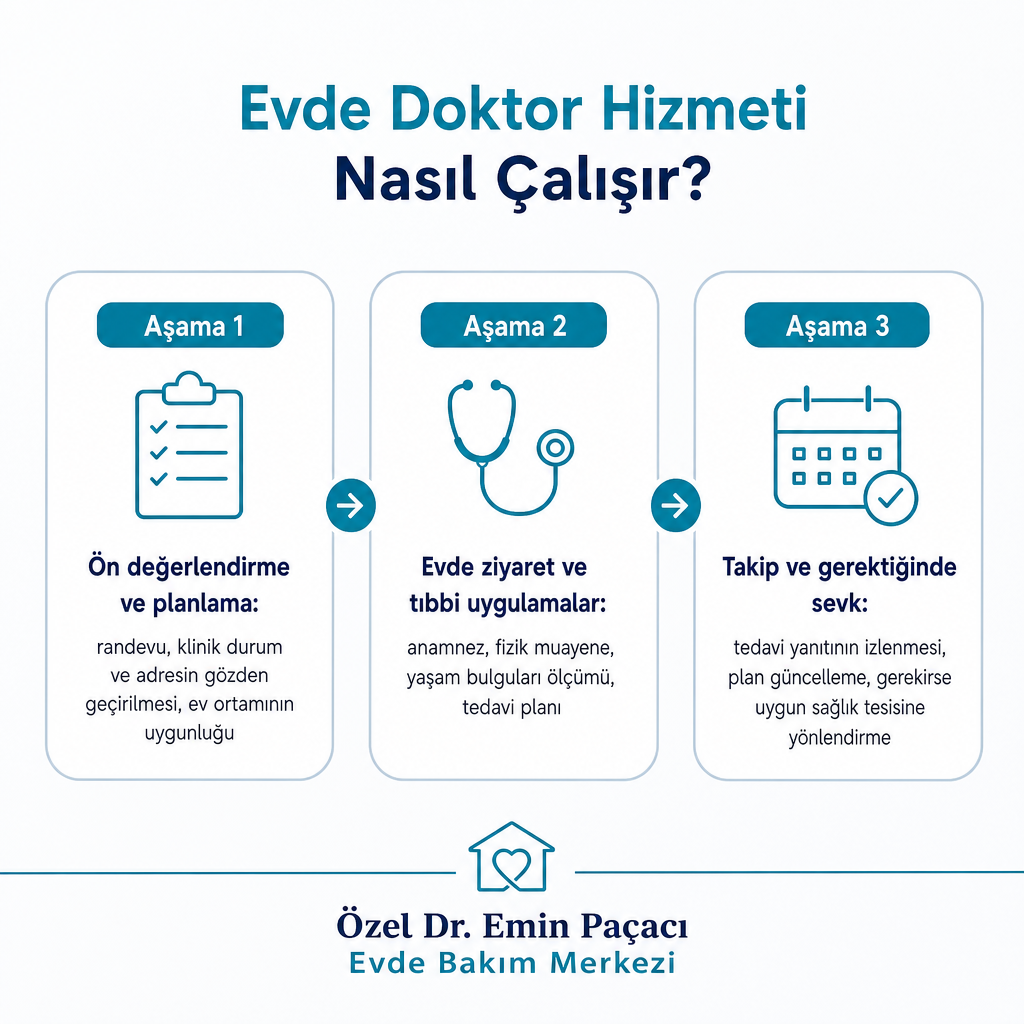 The three-stage functioning of home doctor service
Preliminary evaluation and planning
Home doctor service is generally carried out through an appointment system; the patient's condition, address information, and service scope are reviewed in advance. At this stage, the patient's current diagnoses, recent clinical changes, expectations, and the limits of medical procedures that can be performed at home are evaluated by the physician. At the same time, the suitability of the home environment for medical care and any additional professionals that may be needed (such as nurses or physiotherapists) are analyzed. The evaluation and treatment decision belong to the physician; due to individual differences, the path to be followed may vary for each patient.
Home visit and medical applications
At the scheduled appointment time, the physician comes to the patient's home and the consultation begins with the medical history; the patient's complaints, chronic illnesses, medications used, and previous test results are reviewed. Then, basic clinical steps such as cardiac-pulmonary auscultation, abdominal examination, neurological evaluation, and examination of the extremities and joints are performed in the home environment.
Depending on the physician's clinical evaluation, it is possible to measure basic vital signs such as blood pressure, pulse, temperature, and oxygen saturation, to perform certain tests that can be done with portable devices such as ECG, and to plan regular measurements for chronic disease monitoring. At the end of the examination, the physician creates a treatment plan within the framework of a diagnosis or preliminary diagnosis, arranges medication, and may plan necessary tests through home sample collection or referral to a laboratory. In certain clinical situations, home serum and fluid-electrolyte therapy, medical applications aimed at pain control, or palliative care processes can be organized in the home environment. These applications are decided by the physician taking into account the patient's current diagnosis, accompanying illnesses, and potential risks; the scope and duration vary from person to person.
Post-visit follow-up and referral when necessary
Home doctor service is often not limited to a one-time examination; regular visits can be planned for topics such as chronic disease monitoring, wound care, rehabilitation, or palliative care. After the visit, the physician follows up on the clinical findings and treatment response; if deemed necessary, updates medication arrangements, lifestyle recommendations, the care plan, or rehabilitation goals. In cases where the limits of home care are reached and advanced imaging, intensive monitoring, or invasive procedures are required, a referral to an appropriate health facility is planned for the patient in line with the physician's decision.
In which situations might home doctor service come into play?
Among the main target groups of home health services are bedbound patients, elderly individuals who have difficulty reaching health institutions, and people requiring long-term chronic disease monitoring. In our home private medicine content, elderly individuals, bedbound patients, and people with chronic illnesses such as COPD, diabetes, and hypertension are indicated as example groups. In these groups, home doctor evaluation may come into play especially in situations where mobility is limited, hospital processes are challenging, or home palliative care is aimed for.
In elderly individuals, additional risks such as balance issues and falls may also fall within the scope of evaluation; for practical information on this subject, you can review our guide on reducing balance loss and home fall risk in the elderly. In any case, the decision for home evaluation is based on the physician's medical judgment; individual risks and needs should be taken into account.
On the other hand, symptoms that can seriously threaten life such as sudden onset severe shortness of breath, chest pain, or changes in consciousness are generally situations that fall within the scope of emergency health services. In such symptoms, the common practice is to apply to the local emergency health services or emergency departments. Home doctor service is often carried out in the form of planned or semi-planned visits and is not defined as a practice that replaces emergency intervention systems.
Topics considered during the decision-making process
When an evaluation is made for home doctor service, the main topics addressed by the physician and family members complement each other:
- The patient's clinical condition and stability: In situations such as long-term chronic disease monitoring, palliative care needs, or rehabilitation processes, home health services are frequently applied; sudden and high-risk conditions, however, generally require hospital or emergency health systems.
- Mobility limitation and difficulty of access: In cases of bedbound status, disability, or mobility limitation due to advanced age, the examination and care provided at home can be planned as a more sustainable option than frequent visits to health institutions.
- Suitability of the home environment: For medical applications to be carried out at home, basic hygiene conditions, a safe area of movement for the patient, arrangements that reduce fall risk, and the presence of auxiliary equipment if necessary are important.
- Team collaboration and follow-up capability: Home doctor service is often carried out together with nursing, physiotherapy, and, when necessary, palliative care teams; the regular follow-up plan is coordinated among these teams.
These topics create a framework for the physician's clinical decision; the expectations of the patient and family members are evaluated together with medical necessity. When rehabilitation goals are involved, our article on the importance of the home environment in the neurological rehabilitation process, where we address the role of the home environment in more detail, may also support this evaluation.
The scope of home doctor service at our center
The services we offer within the scope of Home Private Medicine include steps such as home physical examination and general evaluation, diagnosis and treatment planning, medication prescription and dosage adjustments, portable test applications such as ECG recording, and home sample collection coordination. In addition, chronic disease monitoring (such as blood pressure, blood sugar, and respiratory parameters), palliative care and pain management, information transfer and counseling to the family, and, when necessary, specialist referral or referral to a health facility processes are also included within this scope.
We carry out home doctor service through an appointment system and can offer a 24/7 service option for emergency situations. We would also like to note that home doctor services are currently not covered under SGK (Social Security Institution) and that payments are made individually. Within this framework, the home doctor request and visit plan are shaped in line with the patient's clinical condition, the expectations of family members, and the physician's medical judgment.
Home doctor service is often planned not alone, but together with services such as home private nursing and home physiotherapy, within the same institutional framework. The examination and treatment plan are determined by the physician; nursing care, rehabilitation, and palliative processes are organized according to this plan. Determining the appropriate scope for you depends on the patient's diagnoses, current clinical condition, and home conditions; therefore, the evaluation is made specifically for the individual.
Frequently Asked Questions
Are home doctor service and public home health service the same thing?
Public home health service is a whole of examination, treatment, care, and rehabilitation defined by regulation and carried out by the Ministry of Health and affiliated institutions. Private home doctor service, on the other hand, refers to the visit and examination services provided by the physician staff of licensed private institutions. Both structures operate within their own legal and organizational frameworks.
Does home doctor service replace the emergency department?
Home health and home doctor services are generally services based on planned or semi-planned visits carried out through an appointment system. Sudden and severe clinical conditions are often evaluated within the scope of the emergency department and the 112 emergency health system; the decision of which condition is an emergency depends on the clinical findings and the physician's evaluation.
For whom does home doctor service come into play more frequently?
Bedbound patients, elderly individuals who have difficulty reaching health institutions, and patients requiring long-term chronic disease monitoring are among the groups for whom this service is frequently applied. Symptoms and needs vary from person to person; it is recommended to consult a physician for evaluation.
Can reports or prescriptions be issued within the scope of home doctor service?
Within the definitions of home doctor service, the physician's creation of a treatment plan after examination, arrangement of medication, and preparation of reports or referral documents when necessary are included. The content and scope of these documents depend on the patient's clinical condition and the physician's discretion in accordance with the relevant legislation.
How does home doctor service relate to other home health professionals?
In the home health approach, the doctor, nurse, physiotherapist, and other professionals working together as a team is a common model. The examination and treatment plan are determined by the physician; nursing care, rehabilitation, and palliative processes are organized according to this plan.