Post-operative in-home nursing care is the continuation of the patient's clinical monitoring and care in the home environment after discharge. It encompasses the performance of nursing duties such as monitoring vital signs after surgery, administering medications and IV fluids planned by the physician, wound and dressing follow-up, and informing the patient and their family, carried out by a professional team at home. The goal is to support the recovery process through continuity of care.
As Özel Dr. Emin Paçacı Home Care Center, a Ministry of Health–licensed home care institution in Üsküdar, Istanbul, we provide this continuity of care in the home environment with our team of physicians, nurses, and physiotherapists. In this article, we neutrally explain what post-operative in-home nursing care is, which duties it covers, its types, and how one can assess whether a patient needs this support.
Contents
What post-operative in-home nursing care is and how it works
Home health care describes a wide range of services an individual receives in the home environment, spanning from nursing care to diagnostic tests. The most common form of this range is nursing care, and it includes elements such as the registered nurse preparing a care plan in line with physician recommendations, wound care, intravenous treatments, medication administration, monitoring of vital signs, and education.
In the post-operative period, this framework functions like a natural extension of surgery. On the journey of surgical patients from the clinic to home, the in-home care nurse largely takes on the continuity of post-discharge care. The nurse's role is not only to perform procedures; educating the patient and their family, monitoring symptoms, and detecting potential complications early are also central to this role.
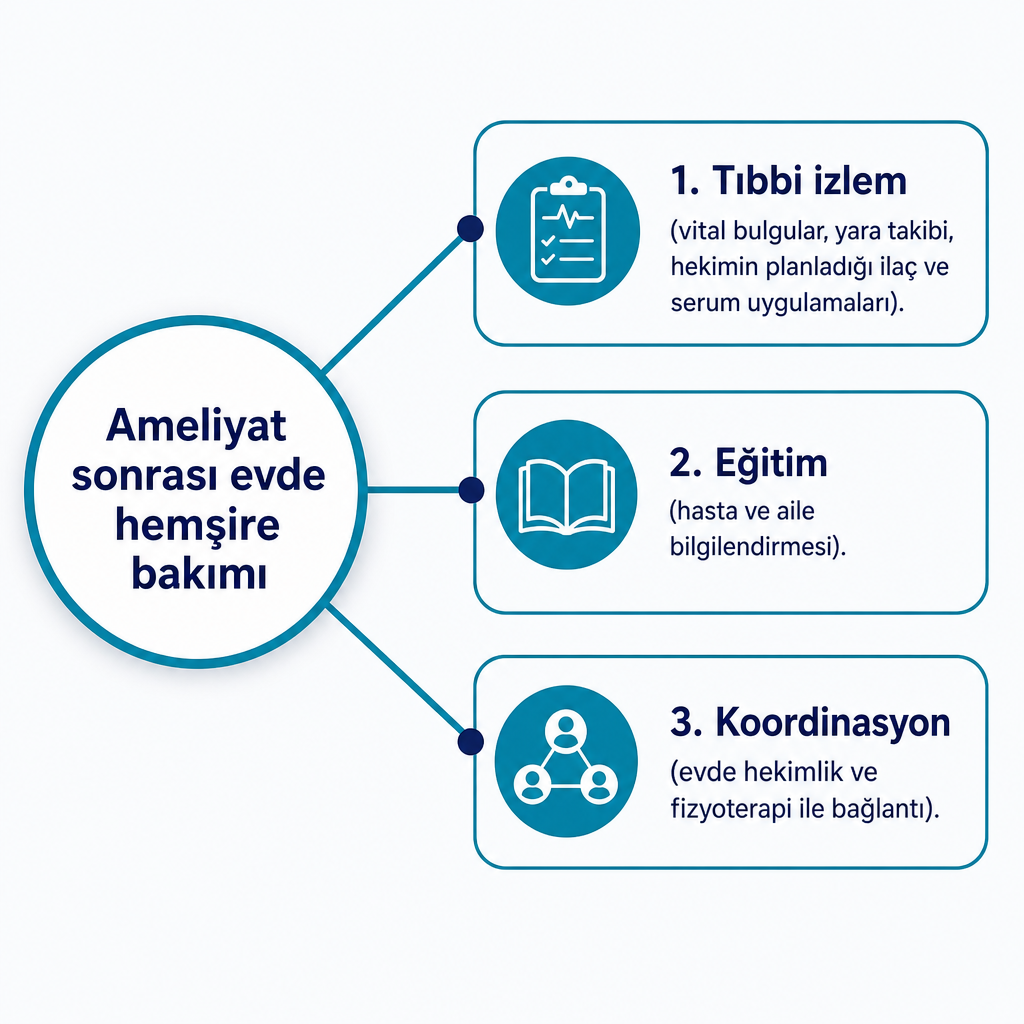
In practice, the mechanism proceeds along three axes. The first is medical monitoring: supporting adherence to the treatment planned by the physician, and follow-up of the wound and vital signs. The second is education: informing the patient and caregivers, because family members may not always have clinical skills. The third is coordination: carrying out care as a whole with complementary services such as in-home physician visits and physiotherapy when needed. In surgical nursing, home care is defined as a comprehensive approach addressing the physical, psychological, and social needs of the patient in the post-operative period.
At this point there is an important boundary: medications, exercises, and restrictions are planned by the physician who performed the surgery. In-home nursing care does not replace this plan; it supports bringing the plan home and implementing it.
Types of care and how they differ
Post-operative home care is not a single service; different roles come together depending on the patient's condition. Distinguishing these roles makes it easier to understand which support corresponds to which need.
In-home private nursing forms the core care in the post-operative period. Our in-home private nursing service brings basic nursing duties—such as monitoring vital signs, administering the treatment planned by the physician, wound and dressing follow-up, and informing the patient and their relatives—into the home environment.
In-home private physician care completes the clinical framework of nursing care. With our in-home private physician service, the post-operative patient's condition can be assessed at home, the treatment plan can be reviewed, and the coordination of follow-up appointments can be supported. The assessment and treatment decision belong to the physician.
In-home physiotherapy addresses the movement and function dimension of recovery. Since mobilization, respiratory exercises, and musculoskeletal rehabilitation gain importance in some patients, our in-home physiotherapy service takes on a separate but complementary role alongside nursing care. The suitability of the exercise program is determined by the relevant physician.
Palliative and long-term home care is defined along the axes of symptom management, comfort, continuity of care, and family support in advanced-stage illnesses or complicated post-operative processes. The common aspect of these types is that they are carried out in the home environment; the point at which they diverge is the intensity of monitoring, the level of clinical complexity, and the duration.
Why it may be important in the recovery process
Discharge is not the moment recovery ends, but the moment it is transferred to a different environment. In surgical patient education materials, topics such as wound care, pain control, sleep hygiene, fall prevention, adherence to medication use, nutrition, and the gradual increase of activity stand out in the post-operative period. Most of these topics arise during the days the patient spends at home.
Professional nursing support at home can gain significance in several respects during this transition period. Among the goals of post-operative care are monitoring signs of infection, observing fluid balance, taking into account mobilization to reduce the risk of thromboembolism, and arrangements to reduce the risk of falls. In a period when complications can be variable and symptoms may differ from person to person, regular monitoring of symptoms lays the groundwork for early detection.
Family and caregiver capacity also come into play here. Even if family members are well-intentioned, they may not always have clinical skills. Sources emphasize that the educational role of nurses fills this gap and contributes to the early recognition of complications. Working within a Ministry of Health–approved, licensed framework ensures that this support is carried out on a supervisable basis; we elaborate on this topic in our article explaining the importance of Ministry of Health–approved home care.
What is considered in the assessment
It cannot be said that every post-operative patient needs in-home nursing support; this is a decision, and the final assessment belongs to the physician. Nevertheless, the literature points to several common criteria in determining this need. The following topics summarize the framework a patient can focus on when speaking with their own physician.
| Assessment topic | What it indicates |
|---|
| Type and scope of the surgery | In major surgeries, cardiac or orthopedic operations, mobility restrictions and the need for intensive wound care may be more pronounced |
| The patient's level of dependency | Continuity of care becomes important in patients who need help with daily living activities, have difficulty walking, or use medical devices |
| Complexity of medication and treatment | The need for multiple medications, injections, or intravenous therapy along with regular dressing changes may make professional monitoring meaningful |
| Family and caregiver capacity | The family's level of clinical skill and time determine the need for the nurse's educational role |
| Conditions of the home environment | Fall risk, hygiene, and the suitability of the environment affect the care plan |
These criteria are not a scoring or self-diagnosis tool. Their purpose is to help the patient and family see the situation concretely and to direct the right questions to the physician. As a result of the assessment, nursing monitoring alone may be sufficient for some patients, while for others a multidisciplinary approach involving physician assessment and physiotherapy may come into play. Symptoms vary from person to person; in the case of new or severe symptoms, consulting a physician is the safe approach.
The next step: assessment with a physician
The decision for post-operative in-home nursing care is shaped by evaluating the type of surgery, general health condition, home conditions, and family support together. The leading role in this assessment belongs to the physician who knows the patient and the surgical process; in-home nursing care is a component that supports bringing this plan home.
Because the nature of the need varies from patient to patient, this assessment also determines which services will come together. When you share the type of surgery, post-discharge recommendations, and home conditions with us, we can clarify together how nursing care can be structured as a whole with physician care and physiotherapy. For those curious about the general framework of home care and how in-home clinical monitoring works in Istanbul, our guide to in-home doctor examinations in Istanbul is a complementary starting point.
Frequently Asked Questions
What does post-operative in-home nursing care cover?
In general, it covers nursing duties such as monitoring vital signs, administering medications and IV fluids planned by the physician, wound and dressing follow-up, and informing the patient and their family. The content of the care is determined according to the physician's treatment plan.
Does this service replace physician care?
No. In-home nursing care supports bringing the treatment planned by the physician who performed the surgery home. The assessment and treatment decision belong to the physician; nursing care complements this plan.
Is in-home nursing support needed after every surgery?
No. The need varies according to factors such as the type of surgery, the patient's level of dependency, the complexity of the treatment, and family support. The individualized assessment is made by the physician.
How do in-home nursing, physiotherapy, and physician care work together?
Nursing care addresses medical monitoring and education, in-home physician care addresses clinical assessment, and physiotherapy addresses movement and functional recovery. Depending on the patient's condition, these roles can be structured together as multidisciplinary care.
What is the legal framework of home care services?
Private health institutions providing home care services are subject to the licensing, personnel qualification, and supervision principles within the scope of the Ministry of Health's relevant regulations. Working within a licensed framework ensures that care is supervisable.